
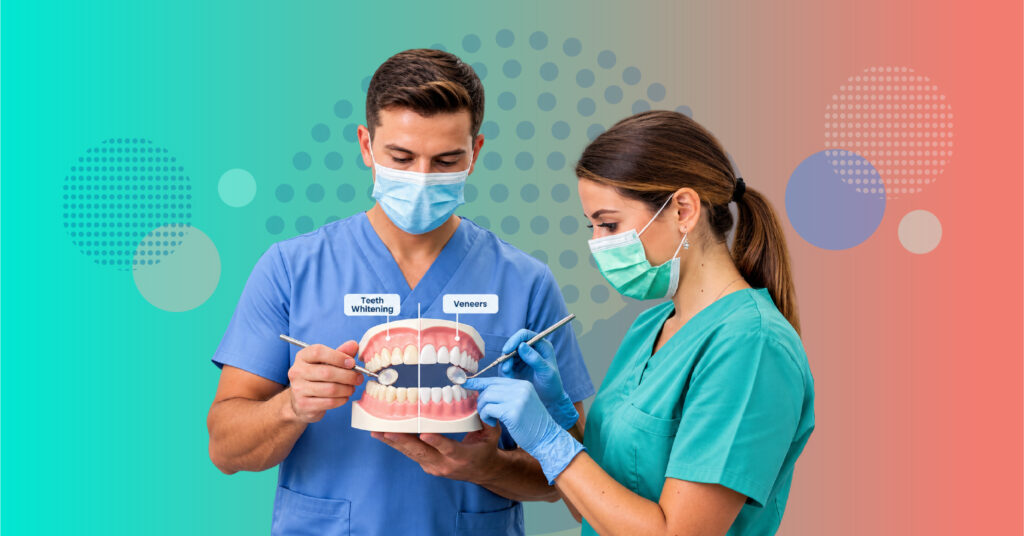
A patient may arrive at a cosmetic dental consultation already knowing the treatment they want. Whiter teeth after seeing a social-media transformation, or veneers for a brighter, more symmetrical smile that resembles a reference image.
Teeth whitening vs veneers is not simply which produces bigger change. The two solve different problems and carry different biological commitments. Whitening changes tooth color while preserving tooth structure; veneers can change color, shape, proportion and surface appearance, but require more detailed case selection and may involve irreversible preparation.
To understand how dentists approach these decisions, MDForLives surveyed dentists across the USA, UK, Canada, Italy, France and Germany. The detailed findings are available in the MDForLives Cosmetic Dentistry and Social Media: Where Patient Requests Meet Clinical Limits Insight Report.
The requested treatment is not always the starting point
Whitening and veneers are both highly visible in modern cosmetic dentistry. In the MDForLives survey, 38.4% of dentists identified teeth whitening as the cosmetic request, most often linked to social-media exposure, closely followed by porcelain veneers at 34.9%.
Yet those requests may describe the desired appearance more than the clinical problem. The first task is to translate the requested procedure into a treatment objective. What does the patient actually want to be changed, is it color or shape, and are restorations involved? The requested procedure is the start of the conversation, not its conclusion.
Periodontal health can change the conversation first
Once the aesthetic goal is clear, clinical suitability comes next. In the survey, 51.2% of dentists identified active periodontal disease as the finding most likely to change treatment suitability, so the choice between whitening and veneers sometimes comes too early.
A patient may be focused on shade or tooth form while examination identifies inflammation, periodontal instability or another condition that should be addressed first. In that situation, the answer may not be “whitening” or “veneers.” It may be “not yet.”
Healthy teeth and gums are the foundation of successful dental care. Explore the connection between oral health and overall health and why underlying conditions deserve attention.
Periodontal treatment, reassessment or management of another underlying problem may need to precede elective aesthetic care.
This keeps cosmetic treatment in the right sequence: establish oral health first, then decide how much intervention the aesthetic objective actually requires.
When the problem is color, whitening preserves more
If the mouth is suitable, the next question is whether the goal can be achieved without restorative treatment. When the concern is predominantly shade, whitening offers a clear preservation advantage, altering tooth color without removing healthy tooth structure. In the MDForLives survey, 51.2% of dentists selected professional tooth whitening as the treatment that best fits a minimally invasive aesthetic case.
Whitening is not right for every discoloration: the cause matters, crowns and veneers may not respond like natural teeth, and sensitivity and gingival health affect suitability. But when color is the main problem and conditions are appropriate, whitening may deliver enough improvement without a restorative commitment.
Veneers, when the problem is bigger than shade
Whitening also has clear limits. It cannot correct every concern involving tooth shape, proportions, surface form, structural defects or position, where veneers may become a relevant cosmetic dentistry treatment option. The decision should be based on what the veneers need to solve, not how dramatic the requested transformation appears.
Planning may consider enamel availability, tooth position, periodontal health, occlusion, parafunction, restorations, and preparation. The essential difference is whitening asks whether changing color solves enough of the concern; veneer planning asks whether the remaining problem justifies the added restorative commitment, which only matters after the first is answered.
Irreversibility raises the threshold
As treatment becomes more irreversible, the rationale for it should become stronger. In the MDForLives survey, 32.1% of dentists identified irreversible tooth preparation as the social-media-driven request most likely to require substantial modification, sharpening the preservation principle.
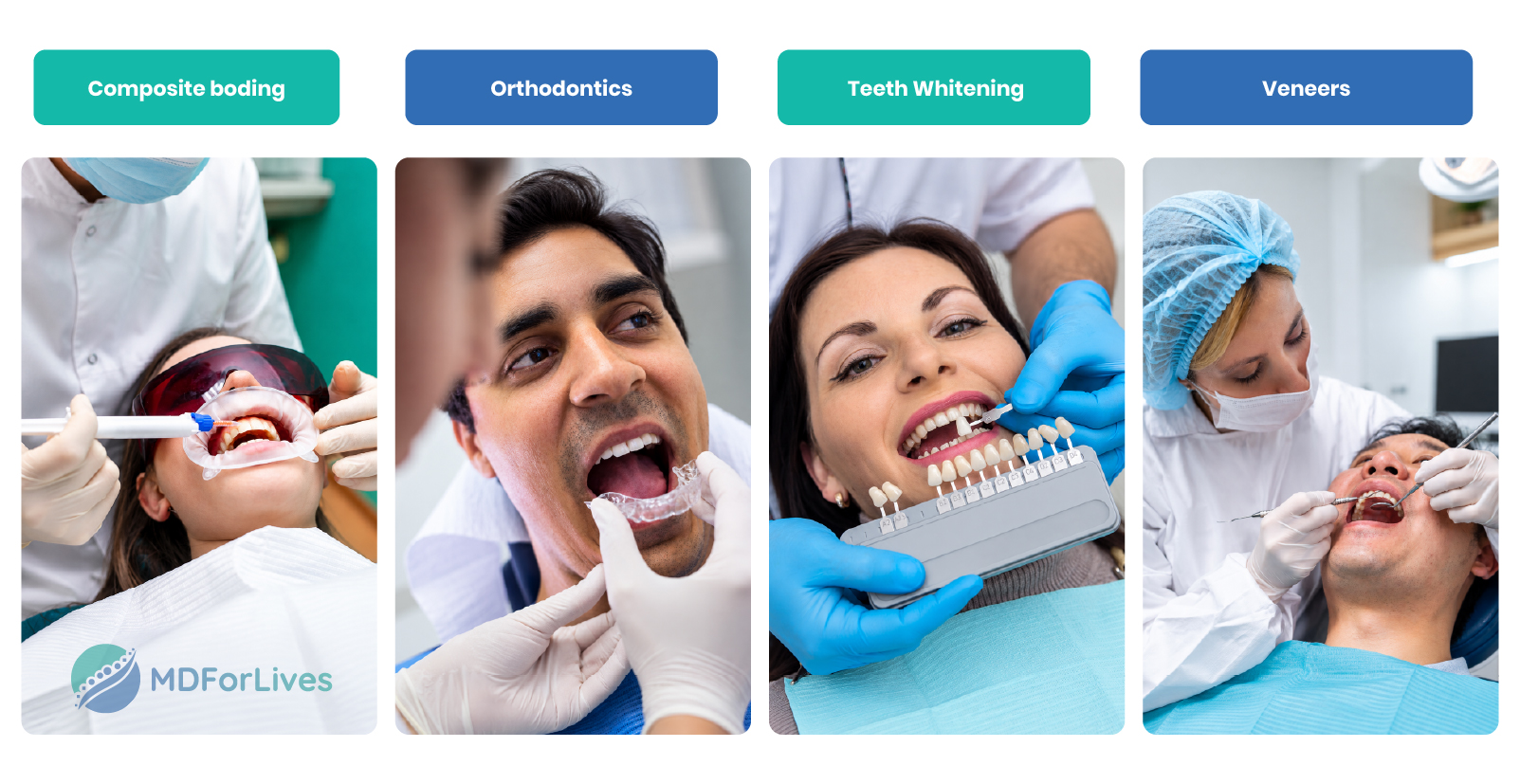
If the requested appearance would remove more healthy tooth structure than the benefit justifies, the pathway may need to change. Whitening might test how much of the concern is color-related; bonding may address selected changes, and orthodontic movement may reduce correction when position contributes.
A conservative alternative is not a rejection
Changing the proposed treatment does not mean rejecting the goal behind it. In the MDForLives research, 46.4% of dentists said they offer a conservative alternative when a cosmetic request is unrealistic, an important distinction in shared decision-making.
A patient requesting veneers may still have a reasonable goal, a lighter shade, better symmetry, or a balanced smile, which the dentist can preserve while changing the approach. Whitening, bonding, orthodontic movement, or a staged combination may achieve enough improvement without the most invasive option. The message is not “you cannot have what you want,” but “here is the least invasive way to get there.”
Good clinical communication helps patients understand treatment limitations and make informed decisions without losing sight of their goals. Explore the art and science of doctor-patient communication.
Expectations shape the success of either option
Even a technically successful treatment can disappoint when the expected endpoint is never aligned. In the survey, 57.1% of dentists identified unrealistic outcome expectations as the biggest limitation to effective cosmetic treatment counseling. This matters when social media provides the reference image, because a photo rarely shows the starting condition, treatment sequence, preparation, maintenance needs, or compromises behind the final look.
Whitening improves shade without the uniform color possible with restorations; veneers achieve broader change but introduce different biological and maintenance commitments. So, expectation-setting should happen before the procedure is chosen. What will whitening realistically change, and what would veneers solve at what biological cost? An expectation gap can become an outcome gap even when the dentistry is technically sound.
Closing perspective: choose the goal before the procedure
The question behind teeth whitening vs veneers is not which is better, but which fits the problem. If color is the main concern and the teeth are suitable, whitening may improve the smile while preserving structure; if shape, surface form or structural problems are involved, veneers become more relevant, but only after periodontal health, enamel, occlusion, position and biological cost are considered.
That is the value of conservative cosmetic dentistry. Start with the patient’s goal, establish suitability, use the least invasive option capable of meeting it predictably, and escalate only when that cannot solve the remaining problem. The best plan is not the one that changes the smile most, but the one that achieves the right change without asking healthy teeth to give up more than necessary.