









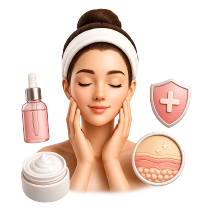



Yes. Repeated irritation from incompatible or overly intensive products can increase dryness, burning, irritation or breakouts and can impair barrier function. Simplifying the routine and matching products to the individual skin condition is often more useful than continually adding active ingredients.
Dermatology Insight Report
Skin Microbiome Claims Under Scrutiny: What Dermatologists Trust, Question and Expect Next
A peer insight report on microbiome-targeted skincare, DTC sequencing, barrier disruption, preservative concerns, regulation and the clinical future of microbiome-directed dermatology.
Audience: Dermatologists
Countries: 6
Survey records: 142
-Hero findings
– Quick Read — Key Findings
🧴
69.5%
🔬
64.7%
🧬
72.7%
➕
57.6%
📋
90.9%
⏳
63.6%
When “microbiome-friendly” is a marketing term, a biological idea and a possible future therapy at the same time, how do clinicians separate them?
The full report follows where dermatologists see credible promise, where they see consumer confusion, and which evidence or regulatory gaps matter most.
The skin microbiome is scientifically important, but cosmetic claims and therapeutic evidence do not operate under the same standard
The cutaneous microbiome is increasingly studied as part of barrier function, inflammation and host-microbe interaction. At the same time, “microbiome-friendly,” “probiotic” and similar terms have become common in consumer skincare.
FDA guidance makes a key distinction: cosmetics generally do not require premarket approval, but claims to treat or prevent disease or affect body structure or function can move a product into drug regulation. FDA also emphasizes microbiological safety because cosmetic products can become harmful when contaminated with pathogenic bacteria or fungi.
That regulatory context helps explain the survey pattern. Dermatologists are not rejecting microbiome science. They are asking for clearer evidence before consumer claims are treated as clinically actionable.
Selected external context: US FDA, Cosmetics Labeling Claims; US FDA, Microbiological Safety and Cosmetics; US FDA, Early Clinical Trials With Live Biotherapeutic Products
MDForLives Research Interpretation
Microbiome terminology is already part of routine dermatology conversations
27.8% say patients ask about microbiome-safe, probiotic or barrier-friendly products daily, 41.7% hear these questions weekly, and 30.6% rarely or never do.
What the pattern suggests: The consumer vocabulary has reached the clinic before a standardized clinical framework for interpreting many of the claims.
Why it matters: Clinicians increasingly spend time translating the difference between an emerging biological field and the evidence supporting a specific product.
Most dermatologists accept the science while questioning the commercial translation
64.7% call current microbiome-targeted consumer skincare “scientific exploitation,” 29.4% see genuine innovation, and 5.9% view the category as a pure gimmick.
What the pattern suggests: The dominant position is nuanced rather than dismissive: dysbiosis can be real while a label or formulation still lacks evidence of meaningful clinical benefit.
Why it matters: This distinction is critical for patient communication because it avoids replacing hype with blanket skepticism.
DTC microbiome reports are rarely treated as clinically actionable
51.5% explain that commercial databases lack standardized clinical reference ranges and advise patients to disregard product recommendations. 21.2% actively discourage the tests, while 27.3% use the report to help customize treatment or product selection.
What the pattern suggests: Nearly three quarters do not use the report as a straightforward personalization tool. The missing piece is not data generation, but validated interpretation.
Why it matters: Sequencing can create an impression of precision even when the field lacks agreed thresholds that connect a result to a proven treatment decision.
Microbiome-directed treatment is more often viewed as adjunctive than substitutive
57.6% expect targeted ecosystem management to be an adjunct to established eczema therapy, 21.2% believe it could replace current first-line maintenance, and 21.2% say the microbiome shift is a consequence of underlying host biology rather than the root cause.
What the pattern suggests: The majority position places microbiome intervention inside a broader therapeutic model rather than above it.
Why it matters: That framing supports a host-plus-ecosystem view of inflammatory disease, where barrier and immune biology remain central even if microbial manipulation becomes more precise.
Product overload and preservative anxiety create a second barrier problem
30.3% say more than 35% of their barrier-repair visits are self-induced by product overload, while another 51.5% place the share between 10% and 35%. On preservative-free or “microbiome-gentle” formulations, 21.2% report clear concern about contamination-related complications and 63.6% see a smaller but real need for patient education.
What the pattern suggests: Consumers can pursue “barrier-friendly” routines in ways that paradoxically increase irritation, complexity or contamination risk.
Why it matters: The survey suggests that simpler routines and product safety may matter as much as adding another microbiome-labelled intervention.
Regulation is the strongest point of agreement, while therapeutic timelines remain cautious
27.3% rate strict definitions and testing requirements as highly urgent and 63.6% as moderately urgent. For prescription-grade live biotherapeutics, 63.6% expect a three-to-five-year horizon, 30.3% expect six to ten years or longer, and 6.1% think they are within one to two years.
What the pattern suggests: Dermatologists appear more certain about the need for evidence standards than about when microbiome-directed therapeutics will become routine.
Why it matters: Clearer claim definitions can improve the present market even before the next generation of live therapeutics reaches practice.
What clinicians said when the answer choices disappeared
What respondents were asked
What is the single biggest lie currently being sold to consumers regarding the skin microbiome, and what is the actual biological truth?
A single product can “rebalance” everything
Several responses rejected the idea that a serum or microbiome product can reset the skin ecosystem or solve every skin problem.
Barrier and host biology come first
Respondents repeatedly pointed back to lipid barrier integrity, endogenous disease mechanisms and multifactorial biology rather than a simple bacteria-first explanation.
More products are not automatically better
One response explicitly challenged multi-step routines, arguing that basic moisturization and sunscreen are enough for many people.
The evidence is still developing
Some dermatologists emphasized that the science is promising but not yet strong enough to justify the certainty used in consumer marketing.
Interpretation note: These themes are qualitative and directional. They summarize recurring ideas in substantive open-ended responses and are not presented as weighted percentages.
What this tells us
The survey draws a clear line between microbiome science and microbiome marketing. Dermatologists largely accept the biological relevance of the skin ecosystem, yet they remain cautious about turning a commercial label, a DTC sequencing result or a “probiotic” formulation into a clinical claim. Near-term credibility therefore depends less on bigger promises and more on validated outcomes, safer formulation, simpler routines and clearer regulatory language.
Dermatology
7Endocrinology, Diabetes & Metabolism
7Oncology & Hematology
7Hospital Administration
6Ophthalmology
6Neurology
6Gastroenterology & Hepatology
6Pharmacy
6Primary Care & Family Medicine
6Diabetes, Weight & Metabolic Health
5Surgery & Procedural Care
5Dentistry & Oral Health
5Nurses, NPs & Physician Assistants
5Pediatrics
5
Cardiology
4Laboratory & Diagnostics
4Radiology & Imaging
3Optometry & Optical Care
3Skin & Aesthetic Care
2Insights for Patients & Caregivers
1Social Work & Patient Support
1Cancer Care
1
The findings go deeper.
So can your participation.
Frequently asked questions
What is the skin microbiome?
The skin microbiome is the community of bacteria, fungi, viruses and other microorganisms that live on the skin. Its composition varies by body site, environment, age, skin condition and other exposures, and research is examining how these communities interact with barrier function and inflammation.
Is “microbiome-friendly” a standardized medical claim for skincare?
There is no single globally standardized clinical definition that makes a cosmetic product “microbiome-friendly.” In the United States, cosmetic claims must be truthful and not misleading, and products that claim to treat disease or affect body structure or function may fall under drug requirements.
Are probiotic, prebiotic or postbiotic skincare products proven treatments for inflammatory skin disease?
The field is active but still developing. Evidence depends on the organism, ingredient, formulation and condition being studied. Microbiome-directed products should not be assumed to replace established therapies for acne, rosacea, eczema or other inflammatory disease unless clinical evidence supports that specific use.
How are the skin barrier and microbiome connected?
Barrier integrity and the microbial ecosystem influence each other. Changes in lipids, pH, inflammation, moisture and immune activity can alter which microorganisms thrive, while microbial shifts may also interact with inflammatory pathways. The relationship is therefore more complex than a simple “good bacteria versus bad bacteria” model.
Can an overly aggressive skincare routine damage the skin barrier?
Are at-home skin microbiome tests clinically actionable?
Consumer sequencing can describe microorganisms detected in a sample, but routine dermatology does not yet have universally validated reference ranges or treatment algorithms that turn a single swab result into a diagnosis or personalized prescription. Results therefore need cautious interpretation.
Clinical context sources: American Academy of Dermatology: microbiome education · FDA: Cosmetics Labeling Claims · FDA: Microbiome Research. These FAQs provide general educational context and do not replace specialty guidance or patient-specific clinical judgment.
Direct answers to the questions healthcare professionals are most likely to ask about these findings.