
Hospitals are built to protect health. Yet the systems that keep them running, energy, procurement, waste, infrastructure, transport, and supply chains, also carry an environmental cost.
That is why green healthcare is no longer a side conversation. It is becoming part of how hospitals think about resilience, operational efficiency, procurement, carbon reduction, and long-term public health responsibility.
But moving from sustainability ambition to operational reality is not simple.
A hospital can support sustainability in principle and still struggle to embed it into departmental routines. A leadership team can approve initiatives and still lack ownership across teams. A facility can track some metrics and still lack standardized reporting. A procurement team can want better sourcing decisions and still face cost, supply, and operational constraints.
That is the tension captured in MDForLives survey data: sustainability is visible, but it is not yet fully operational.
Commitment Exists, but It Is Still Emerging
The strongest signal is that sustainability is on the agenda, but not yet fully mature.
In the MDForLives survey data, 50.0% described their organization’s sustainability commitment as an emerging focus with some initiatives in place. Another 25.0% said sustainability is a core strategic priority with defined goals and investments.
This suggests that green healthcare has moved beyond aspiration in many settings. However, the dominant picture is not full integration. It is transition.
That distinction matters. An emerging focus can create pilots, committees, and targeted initiatives. But routine transformation requires more: budgets, metrics, ownership, staff engagement, procurement rules, and operational accountability.
Hospitals are beginning the shift. The challenge is sustaining it beyond isolated projects.
Priorities Are Practical: Energy and Procurement
When asked about the primary sustainability priority, respondents split evenly between energy efficiency and carbon reduction at 50.0%, and sustainable procurement at 50.0%.
This is a meaningful finding because it shows hospital sustainability is being approached through operational levers, not abstract values.
Energy efficiency is often one of the most visible starting points because hospitals run continuously and depend on heating, cooling, lighting, ventilation, sterilization, equipment, and digital infrastructure. Procurement is equally critical because healthcare organizations purchase large volumes of supplies, equipment, pharmaceuticals, devices, and services.
The future of green healthcare will likely be shaped by these two operational fronts: reducing the footprint of facilities and improving the sustainability of what hospitals buy.
Implementation Is Departmental, Not System-Wide
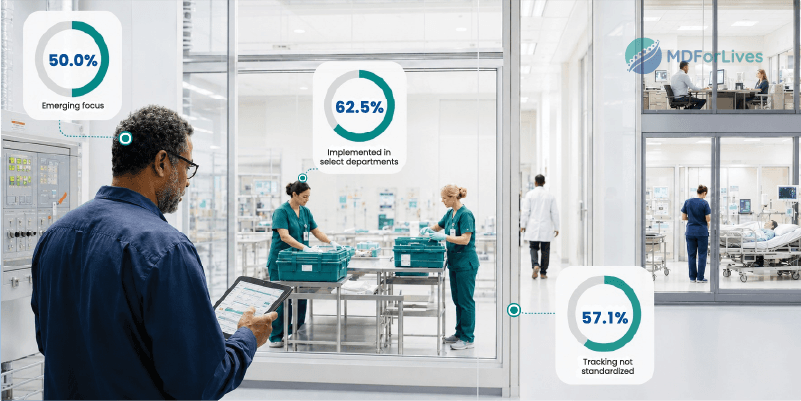
The survey data shows that 62.5% said sustainability initiatives are implemented in select departments. Only 12.5% reported full integration into routine operations and decision-making, while 25.0% described initiatives as pilot phase or early-stage.
This is the clearest implementation gap.
Sustainability is happening, but unevenly. Some departments may be moving ahead through energy optimization, waste segregation, procurement changes, or infrastructure upgrades. Others may have limited participation or unclear responsibility.
That makes green healthcare fragile. If implementation depends on motivated departments rather than a system-wide operating model, progress can remain localized.
The goal is not simply more projects. It is integration into the way decisions are made every day.
Sustainable healthcare depends on more than isolated initiatives; it also requires hospitals to rethink how technology and infrastructure support everyday operations. Explore the role of the smart hospital in shaping the future of healthcare.
Procurement Is Showing Visible Value
When asked which initiative has delivered the most visible operational value so far, 37.5% selected procurement or supply chain changes. Energy optimization and waste reduction each followed at 25.0%.
This finding is important because procurement often sits at the intersection of cost, sustainability, quality, availability, and risk.
Sustainable procurement is not only about buying “greener” products. It can involve supplier standards, lower-waste products, reusable or reprocessable options where clinically appropriate, packaging reduction, lifecycle assessment, and alignment between purchasing decisions and organizational goals.
The data suggests that hospitals may be seeing procurement as a place where sustainability becomes tangible. It is where decisions move from vision to contracts, supplies, and operational routines.
The Financial Case Is Still Not Fully Clear
Financial perception remains mixed. In the survey data, 42.9% described the financial impact of sustainability initiatives as neutral so far. Another 28.6% saw short-term cost increases with expected long-term value, while 14.3% reported visible cost savings.
This is one reason scaling can slow down.
Sustainability often competes with immediate operational demands. Even when long-term value is likely, upfront costs, capital approvals, staff time, and implementation disruption can delay action.
For green healthcare to scale, the financial case needs to be translated into decision language that hospital leaders already use: lifecycle value, risk reduction, resilience, regulatory readiness, efficiency, waste avoidance, and long-term operating cost impact.
If sustainability remains positioned only as an environmental goal, it may be deprioritized when budgets tighten. If it is framed as operational strategy, it becomes harder to sideline.
Staff Engagement Is the Scaling Barrier
The most revealing barrier is not only capital. It is behavior.
When sustainability efforts are deprioritized, 57.1% identified staff adoption and behavior challenges as the most common trade-off. The same percentage also selected limited staff awareness or engagement as a major barrier to scaling sustainability efforts.
This is a key insight for hospital leaders.
Sustainability cannot be delivered only by facilities, procurement, or leadership teams. It depends on thousands of daily behaviors: waste segregation, product choices, energy practices, equipment use, procurement compliance, reporting, and departmental routines.
If staff do not understand the “why,” the workflow, or the operational expectation, sustainability becomes another initiative competing for attention.
Green healthcare needs culture, not just policy.
Leadership Support Is Present, but Ownership Is Uneven
The survey data shows a striking readiness pattern: 85.7% said leadership support is present, but departmental ownership is uneven. Only 14.3% reported strong leadership alignment and active departmental ownership.
This explains why sustainability can appear supported but still stall.
Leadership endorsement may open the door. Departmental ownership determines whether change happens.
A green healthcare strategy needs accountable owners across departments, not only central champions. It also needs sustainability measures that are visible in operational dashboards, procurement reviews, facility planning, and leadership performance conversations.
As healthcare organizations adopt more technology, leadership accountability becomes increasingly important alongside operational goals. Explore the ethics of AI in healthcare, including the risks and accountability questions facing healthcare leaders.
Open-ended survey responses reinforced this need, pointing to management support, dedicated staff, ring-fenced capital funding, procurement reform, measurement frameworks, protected time, and sustainability metrics linked to business KPIs and leadership compensation.
Measurement Is Not Yet Standardized
Measurement is another major gap. In the survey data, 57.1% reported some tracking but not standardized. Another 28.6% described measurement as informal or ad hoc. Only 14.3% reported defined KPIs with regular reporting.
Without measurement, sustainability is hard to manage.
Hospitals need to know what is improving, what is stalled, where emissions or waste are concentrated, which initiatives deliver operational value, and which departments need support.
Better healthcare operations increasingly depend on data that can reveal how systems perform before changes are implemented. Explore how digital twins are transforming healthcare and supporting more informed operational decisions.
This is where green healthcare becomes operationally real. What gets measured can be prioritized. What gets reported can be improved. What gets assigned can be owned.
Closing Perspective
Green healthcare is moving from vision to expectation, but the transition is incomplete.
MDForLives survey data shows that hospitals are taking sustainability seriously, especially around energy efficiency and procurement. Initiatives are underway, and some operational value is visible.
But scaling remains difficult because implementation is still departmental, financial value is not always clear, staff engagement is uneven, ownership is fragmented, and measurement is often not standardized.
The next phase of sustainable healthcare will not be defined only by better intentions.
It will be defined by operational design.
Hospitals need clear owners, reliable KPIs, funded priorities, staff engagement, procurement alignment, and leadership accountability. Without those, sustainability will remain a set of initiatives. With them, it can become part of how healthcare organizations run.
That is when green healthcare moves from aspiration to operating reality.