
The ethics of AI in healthcare has moved from a theoretical discussion to an operational and leadership priority. As healthcare organizations increasingly integrate artificial intelligence into diagnostics, patient monitoring, clinical workflows, and operational decision-making, the implications now extend far beyond efficiency and automation alone. AI systems are beginning to influence how patients are prioritized, how risks are identified, and how clinical recommendations are generated across healthcare environments.
This rapid expansion has created a new layer of responsibility for healthcare leaders. Organizations are no longer being evaluated solely on whether AI improves productivity or supports innovation. They are also being scrutinized on whether these systems operate safely, transparently, fairly, and consistently across patient populations. Questions surrounding accountability, bias, explainability, data governance, and patient trust are becoming central to how healthcare institutions approach AI adoption.
As a result, ethical AI governance is no longer limited to technical teams or innovation departments. It has become a board-level issue that directly impacts enterprise risk, regulatory exposure, patient safety, and organizational credibility.
Why Ethics of AI in Healthcare Has Become a Leadership Priority
Artificial intelligence is now embedded across multiple areas of healthcare delivery. Hospitals and healthcare systems increasingly rely on AI-supported imaging tools, predictive analytics, workflow automation, triage systems, and clinical decision support platforms to improve efficiency and accelerate care delivery. While these technologies offer operational advantages, they also introduce new risks when decisions influenced by algorithms directly affect patient outcomes.
Read more on Smart Hospital Technology
Unlike traditional digital tools, AI systems continuously influence interpretation, prioritization, and recommendations. This creates ethical concerns when organizations cannot fully explain how decisions are generated or when models behave inconsistently across different care settings. A single failure involving patient harm, biased outputs, or inaccurate recommendations can quickly escalate into regulatory scrutiny, reputational damage, and legal exposure.
Healthcare leaders are therefore under growing pressure to establish governance structures that ensure AI systems remain accountable, transparent, and clinically reliable. Ethical oversight can no longer be delegated entirely to vendors or technical teams because the consequences of failure affect the organization as a whole. Leadership accountability now extends into how AI systems are selected, monitored, validated, and integrated into patient care pathways.
Read Clinical Survey Insights on topic AI in Healthcare

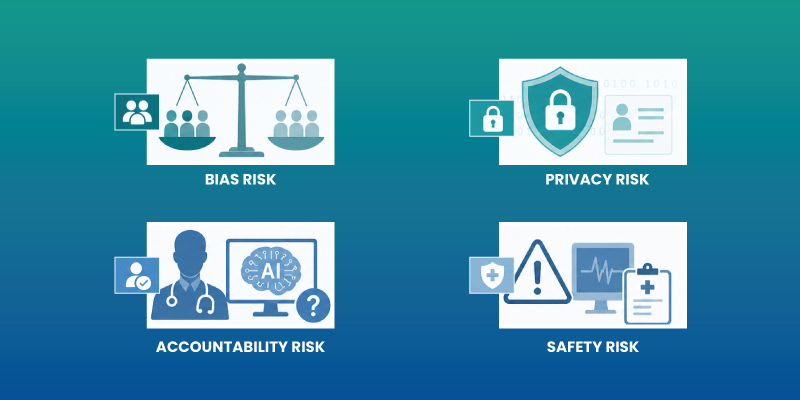
Ethics of AI in Healthcare – Where Ethical Risks Emerge in AI-Enabled Healthcare
Patient Trust, Transparency, and Informed Decision-Making
One of the most significant ethical challenges surrounding AI in healthcare is transparency. Many advanced AI systems operate through highly complex models that are difficult for clinicians and patients to fully interpret. When healthcare professionals cannot clearly explain how a recommendation was generated, maintaining patient trust becomes increasingly difficult.
This issue becomes particularly important in high-risk or life-altering medical decisions where patients expect clarity and accountability. Informed consent becomes more complicated when individuals do not fully understand how AI contributes to diagnostic or treatment decisions. Ethical concerns therefore emerge not only from the technology itself, but from the growing gap between algorithmic outputs and human interpretability.
Healthcare organizations must ensure that AI supports clinical understanding rather than replacing it. Transparency and explainability are essential for preserving confidence in both care delivery and institutional credibility.
Clinical Safety and Reliability
AI systems may perform well during controlled testing but behave differently in real-world clinical environments. Variations in patient populations, workflows, healthcare infrastructure, and data quality can significantly influence system performance after deployment.
Overreliance on algorithmic recommendations may also weaken clinical judgment if healthcare professionals begin treating AI outputs as definitive rather than supportive. Inaccurate predictions, flawed recommendations, or automation errors can scale rapidly when systems are integrated across large healthcare networks.
For this reason, ethical AI adoption requires continuous validation, human oversight, and clearly defined escalation pathways when inconsistencies emerge.
Data Governance, Privacy, and Consent
AI systems rely heavily on large volumes of patient data to train and optimize performance. As healthcare organizations expand data-sharing ecosystems across platforms, providers, and technologies, concerns surrounding privacy, ownership, and consent become more complex.
Many healthcare institutions now face difficult questions regarding secondary data use, long-term storage, cross-platform sharing, and the extent to which patients understand how their information contributes to AI development. Larger datasets may improve model performance, but they also increase exposure to cybersecurity threats, misuse, and compliance risks.
Strong data governance frameworks are therefore essential for maintaining both regulatory alignment and patient trust.
Bias, Equity, and Fairness
Bias remains one of the most widely discussed ethical concerns in healthcare AI. Algorithms trained on incomplete, historically imbalanced, or demographically narrow datasets may produce inconsistent outcomes across different patient populations.
These disparities can influence diagnostic accuracy, treatment prioritization, and access to care. In healthcare, such inconsistencies are not simply technical limitations. They can directly contribute to unequal health outcomes across age groups, socioeconomic populations, ethnic communities, and geographic regions.
As a result, bias management must be treated as both a clinical safety issue and an organizational governance responsibility. Ethical AI systems require continuous evaluation across diverse populations rather than one-time validation exercises.
Accountability and Liability
Determining accountability when AI-related harm occurs remains one of the most unresolved areas in healthcare governance. Responsibility may involve healthcare providers, developers, administrators, vendors, or multiple stakeholders simultaneously.
Current legal and regulatory frameworks continue evolving as AI adoption accelerates. However, uncertainty surrounding liability does not remove organizational responsibility. Healthcare institutions must establish clear accountability structures that define oversight responsibilities before deployment occurs.
Ethical governance depends on ensuring that AI-assisted decisions remain reviewable, traceable, and subject to human intervention when necessary.
Read more on Ethical Issues in Healthcare
Ethical Responsibilities Across the AI Lifecycle
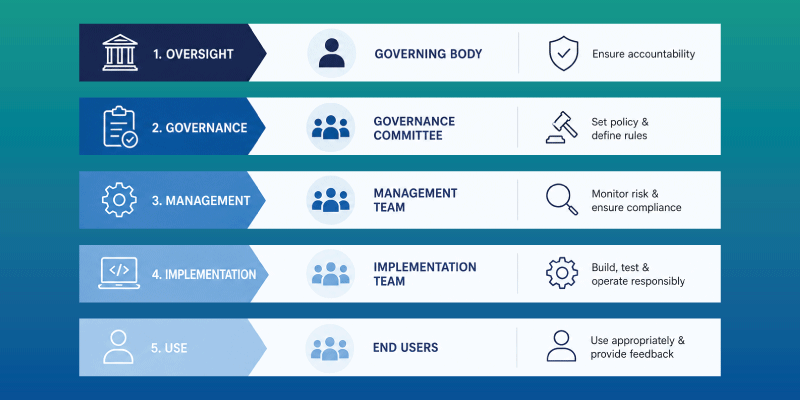
Ethical AI governance requires participation from multiple stakeholders throughout the entire lifecycle of deployment and monitoring.
Technology developers and AI partners are responsible for building systems that prioritize data quality, transparency, explainability, and fairness. Models should be tested across diverse healthcare environments to identify performance limitations before widespread implementation.
Healthcare organizations and executive leadership teams must establish governance frameworks that align AI adoption with patient safety priorities, compliance expectations, and enterprise risk management strategies. This includes defining acceptable use cases, monitoring long-term performance, and ensuring adequate oversight resources remain in place.
Clinical teams play an equally important role by validating recommendations, maintaining independent clinical judgment, and reporting inconsistencies that may affect patient care quality.
At the regulatory level, policymakers and oversight bodies continue shaping standards related to transparency, compliance, accountability, and responsible AI implementation across healthcare systems.
Oversight and Review on Ethics of AI in Healthcare
AI governance in healthcare cannot function as a static compliance exercise. Ethical oversight must operate as a continuous system that evolves alongside technology, workflows, and patient expectations.
Effective governance frameworks establish clear standards for data management, model validation, acceptable deployment scenarios, accountability structures, and human review processes. Organizations must also implement continuous monitoring systems that evaluate real-world performance after deployment rather than relying solely on pre-launch testing.
Frontline reporting mechanisms are equally important because clinicians and operational teams are often the first to identify unexpected system behaviors or workflow disruptions. Governance systems should therefore include escalation pathways, audit structures, and regular reassessment cycles that allow organizations to adapt quickly when risks emerge.
Most importantly, healthcare leaders must recognize that AI governance is directly tied to organizational trust. Patients, clinicians, regulators, and healthcare partners increasingly expect transparency regarding how AI systems influence decision-making and patient care outcomes.
Ethics of AI in Healthcare – Balancing Innovation with Ethical Responsibility
Healthcare organizations face growing pressure to accelerate AI adoption in response to workforce shortages, operational inefficiencies, rising patient volumes, and increasing demand for predictive care models. However, rapid implementation without adequate governance can introduce long-term operational and reputational risks.
Ethical AI adoption requires balancing innovation with accountability. Organizations that prioritize speed over oversight may expose themselves to patient safety concerns, compliance failures, and declining trust among healthcare professionals and patients.
Responsible leadership involves creating systems where innovation remains aligned with transparency, clinical oversight, continuous validation, and equitable patient outcomes. Ethical governance should function as an enabler of sustainable innovation rather than a barrier to technological progress.
Can AI Be Used Ethically in Healthcare?
AI can support ethical healthcare delivery when organizations implement strong governance structures, maintain human oversight, validate performance continuously, and prioritize transparency throughout deployment.
However, significant limitations remain. AI systems still face challenges related to data quality, explainability, bias, interoperability, and variability across healthcare settings. Ethical risks cannot be fully eliminated because healthcare environments themselves are highly complex and constantly evolving.
This means ethical AI is not a one-time achievement. It is an ongoing organizational discipline that requires continuous monitoring, adaptation, and accountability as technologies mature and healthcare expectations change.
Conclusion: What Healthcare Leaders Must Prioritize
The future of AI in healthcare will not be defined solely by technical advancement. It will also be shaped by how effectively organizations manage trust, accountability, transparency, and patient safety alongside innovation.
Healthcare leaders must recognize that ethical governance is no longer optional or isolated within compliance functions. It must be embedded across organizational strategy, operational oversight, technology adoption, and clinical decision-making frameworks.
Organizations that succeed with AI long term will likely be those that treat governance as a continuous responsibility rather than a deployment milestone. As AI systems become more deeply integrated into healthcare delivery, trust itself may become one of the industry’s most valuable operational and strategic assets.
Explore more healthcare insights and research perspectives at MDForLives