

A laboratory can have the right equipment, the right processes, and the right quality systems, but still struggle when people do not feel safe enough to speak up.
That is the hidden pressure point in modern laboratory medicine.
Clinical laboratories work in high-precision environments where errors matter, turnaround time matters, and staffing capacity matters. Every specimen, result, workflow delay, or communication gap can affect downstream care. Yet the people keeping these systems running are often doing so under rising workload, repetitive pressure, staffing constraints, and limited recovery time.
That is why a psychologically safe laboratory culture is no longer only a workforce well-being ideal. It is a quality and safety requirement.
MDForLives survey data shows a complex picture: lab leaders recognize the importance of staff well-being and psychological safety, but daily operations still create visible stress, uneven communication, and burnout concentrated in certain teams.
Lab Culture Is Supportive in Parts, Strained in Others
The survey data shows that laboratory culture is not uniformly poor, but it is also not consistently strong. About 30.0% described their lab as highly supportive and psychologically safe. Another 20.0% said the culture is generally positive but inconsistent across teams.
At the same time, 40.0% described their laboratory culture as challenging, with visible stress and burnout.
That contrast matters.
It suggests many labs are not starting from a place of indifference. Some teams have open cultures, supportive leaders, and learning-oriented approaches. But those strengths are not always stable across roles, shifts, or departments.
A psychologically safe laboratory culture cannot depend only on individual managers or “good teams.” It has to survive high workload, handoff pressure, staffing gaps, and error-sensitive moments.
Well-Being Is a Priority, but It Competes With Operations
The MDForLives survey data shows that staff well-being and psychological safety are on the leadership agenda. About 40.0% said they are a core strategic priority, and another 40.0% said they are important but balanced with operational demands.
This is encouraging, but it also explains the tension.
In labs, operational demands are not optional. Results must go out. Quality must be maintained. Staffing gaps must be covered. Instruments must run. Teams must respond to surges and delays.
So even when leaders value psychological safety, the daily operating model may still reward speed, output, and error avoidance more visibly than reflection, recovery, or open discussion.
The issue is not whether leaders care. The issue is whether the system gives them enough room to act on that care.
Burnout Is Present, but Unevenly Distributed
Burnout in the survey data appears concentrated rather than universal. About 20.0% said burnout is widespread and visible, while 40.0% said it is common in certain roles or teams.
This is an important distinction.
A lab may not appear to be “in crisis” overall, yet specific teams may be carrying disproportionate pressure. Night shifts, high-volume sections, understaffed departments, or roles with repetitive high-stakes tasks may experience burnout more intensely.
That makes resilience a local problem as much as an organizational one. Leaders need to identify where stress is accumulating, not only whether burnout exists at a general level.
Staffing and Workload Remain the Core Driver
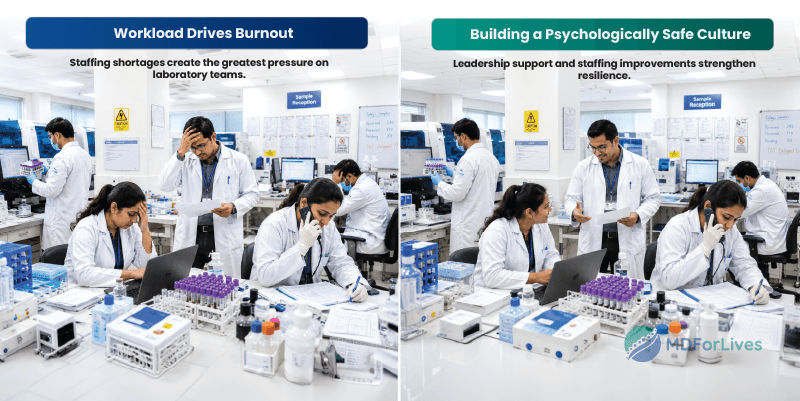
The strongest burnout driver is clear: 50.0% selected workload and staffing shortages as the single biggest driver of burnout in their lab environment.
This finding sets the tone for the entire topic.
A psychologically safe laboratory culture cannot be built on messaging alone if workload remains structurally unmanageable. Training, check-ins, open-door leadership, and well-being programs may help, but they cannot fully offset persistent understaffing or unrealistic workload expectations.
The survey data also shows that 44.4% said increased staffing or workload capacity would most improve their ability to build a resilient and psychologically safe lab culture.
That is the practical truth. Psychological safety improves when staff feel they can speak up. But resilience improves when the workload itself becomes more sustainable.
Speaking Up Exists, but It Is Not Equally Safe Everywhere
The survey data gives a mixed signal on speaking up. About 50.0% said staff are very comfortable speaking up about errors, concerns, or workload issues in an open culture. But 40.0% said comfort is mixed and varies by team or leadership.
That variation is critical.
Psychological safety is often experienced locally. Staff may feel safe with one supervisor but cautious with another. They may speak up in one shift but stay quiet in another. They may report technical problems but hesitate to raise workload concerns, fatigue, or near misses.
Open-ended responses in the survey data reinforced this gap, pointing to fear of blame, judgment, career consequences, pressure to deliver results, and inconsistent handling of staff concerns.
The ideal of a psychologically safe laboratory culture is openness. The reality is that openness can disappear quickly when pressure rises.
Errors Are Often Handled Constructively, but Blame Sensitivity Remains
One positive finding is that 60.0% said errors are most often handled through open discussion focused on learning and improvement. Another 30.0% reported structured review with some blame sensitivity.
This suggests many labs have moved away from purely punitive error cultures.
But “some blame sensitivity” is still meaningful. In high-precision environments, staff may support learning in principle while still worrying about personal consequences. That hesitation can affect transparency, near-miss reporting, and early escalation.
A learning culture is not defined by what happens after obvious errors alone. It is defined by whether people feel safe enough to raise concerns before harm occurs.
As automation and AI become more involved in laboratory workflows, psychological safety and clear accountability remain important parts of safe implementation. Explore whether the clinical lab is ready for AI as an active partner.
High Pressure Breaks Communication First
When asked what tends to break down first under peak workload or staffing shortages, 50.0% selected communication and coordination. Error reporting and transparency, along with staff well-being and morale, followed at 20.0% each.
This is one of the strongest operational insights.
Under pressure, the first failure may not be technical. It may be relational and informational. People stop updating each other clearly. Handoffs become thinner. Escalation slows. Teams make assumptions. Staff protect time by reducing communication, even when communication is what protects safety.
That is why a psychologically safe laboratory culture must be designed for pressure conditions, not only normal days.
What Helps: Leadership Behavior and Workflow Improvement
The most meaningful interventions were leadership behavior or communication changes and process or workflow improvements, both selected by 33.3%.
This points to a balanced path forward.
Labs need leadership behaviors that make speaking up safe and expected. They also need workflow fixes that reduce avoidable stress, rework, confusion, and bottlenecks.
As laboratory workflows become more automated, staff roles are also changing from routine bench work toward greater oversight of systems and processes. Explore whether lab technicians are becoming automation managers.
Culture and systems cannot be separated. A leader can encourage openness, but if the workflow remains chaotic, staff will still burn out. A process can be improved, but if staff fear speaking up, problems will stay hidden.
Closing Perspective
Laboratory burnout is not only an individual resilience issue. It is a systems signal.
MDForLives survey data shows that lab leaders understand the importance of psychological safety. Many labs already have open discussions, formal well-being assessments, and leadership attention on the topic. But the pressure points remain clear: staffing shortages, workload, uneven team culture, communication breakdowns, and limited leadership bandwidth.
A psychologically safe laboratory culture is not built through slogans. It is built through staffing capacity, accountable leadership, consistent team norms, better workflows, and measurable action on staff feedback.
The future of resilient laboratory culture will depend on whether labs can protect both accuracy and people.
Because when the lab is under pressure, the first question is not only whether the process holds.
It is whether the team can still speak, coordinate, and recover.