Care at home can mean very different things. One patient receives nursing, rehabilitation or support after leaving hospital; another stays at home while receiving observation, treatment and diagnostics that would otherwise require an inpatient admission. Both happen in the home but are not the same model of care.
Acute hospital care at home is not simply an expanded version of home health care; it changes the location of hospital level care without removing the responsibilities of acute treatment.
To understand what makes it possible, MDForLives surveyed hospital and health-system leaders across the USA, Canada and Italy. The findings are available in the MDForLives Hospital-at-Home: What Healthcare Leaders Say Will Make It Scale Insight Report.
Home health care and hospital-at-home solve different problems
Traditional home health care supports patients who need skilled nursing, rehabilitation or ongoing monitoring at home, but it does not replace an acute inpatient admission. A hospital at home model is different because it begins with a patient who has an acute-care need that would otherwise require hospital treatment. The model is designed to deliver hospital-level care safely in the home through coordinated physician oversight, nursing support, medication management, diagnostics, remote monitoring and clearly defined escalation pathways. For AHPs and hospital administrators, this means coordinating a broader clinical infrastructure around the patient and ensuring that the right services, monitoring and response mechanisms remain available throughout the episode of care.
Nursing care increasingly extends beyond hospital walls through virtual assessment, remote monitoring and coordinated patient support. Discover how telehealth nursing is transforming patient care.
Home heath care eligibility answers a different question
Home health care eligibility can be confusing, because eligibility for one home-based service does not mean eligibility for hospital-at-home. Home health care may suit a patient needing skilled support deliverable outside an inpatient setting, with criteria varying by service, system, payer and country. Hospital-at-home asks a more acute question: can this patient safely receive hospital-level treatment outside hospital?
In the MDForLives research, 53.8% of healthcare leaders identified clinical stability as the factor that most determines hospital-at-home eligibility. Diagnosis alone does not make a patient suitable; stability, risk of deterioration, home environment, required services, support and rapid return to hospital-level resources all matter. Eligibility is the first major distinction here. The issue is not whether care can happen in the home, but whether the whole acute-care plan can work there safely.
Hospital-level care at home needs more than a suitable patient
A suitable patient is only the beginning. Once someone enters acute care at home, the service still reproduces many hospital functions. Observation must continue, treatment must arrive on time, diagnostics may be required, clinicians need current information, and changes in condition must be recognized, including when the home is no longer the safest place for care.
For professionals, this makes a hospital at home model a distributed acute-care system depending as much on coordination and response capability as on the treatment delivered.
Remote monitoring helps recreate clinical visibility
Inside a hospital ward, observation is built in; at home, some of that visibility must be deliberately recreated. In the MDForLives survey, 42.3% of leaders identified remote patient monitoring as the most critical capability for launching hospital-at-home care.
But a monitor alone does not create oversight; its value depends on what happens after the data arrives. ‘Who reviews it, what change requires action, who contacts the patient, and when does deterioration require transfer?’ These questions separate hospital level care at home from a service that only collects data remotely. Technology extends visibility beyond visits but becomes part of acute care only when connected to a clinical response.
Wearable devices can extend health monitoring beyond traditional clinical environments, but their value depends on how the collected information is used. Explore wearable health technology and its role in modern healthcare.
The difference becomes clearest when something changes
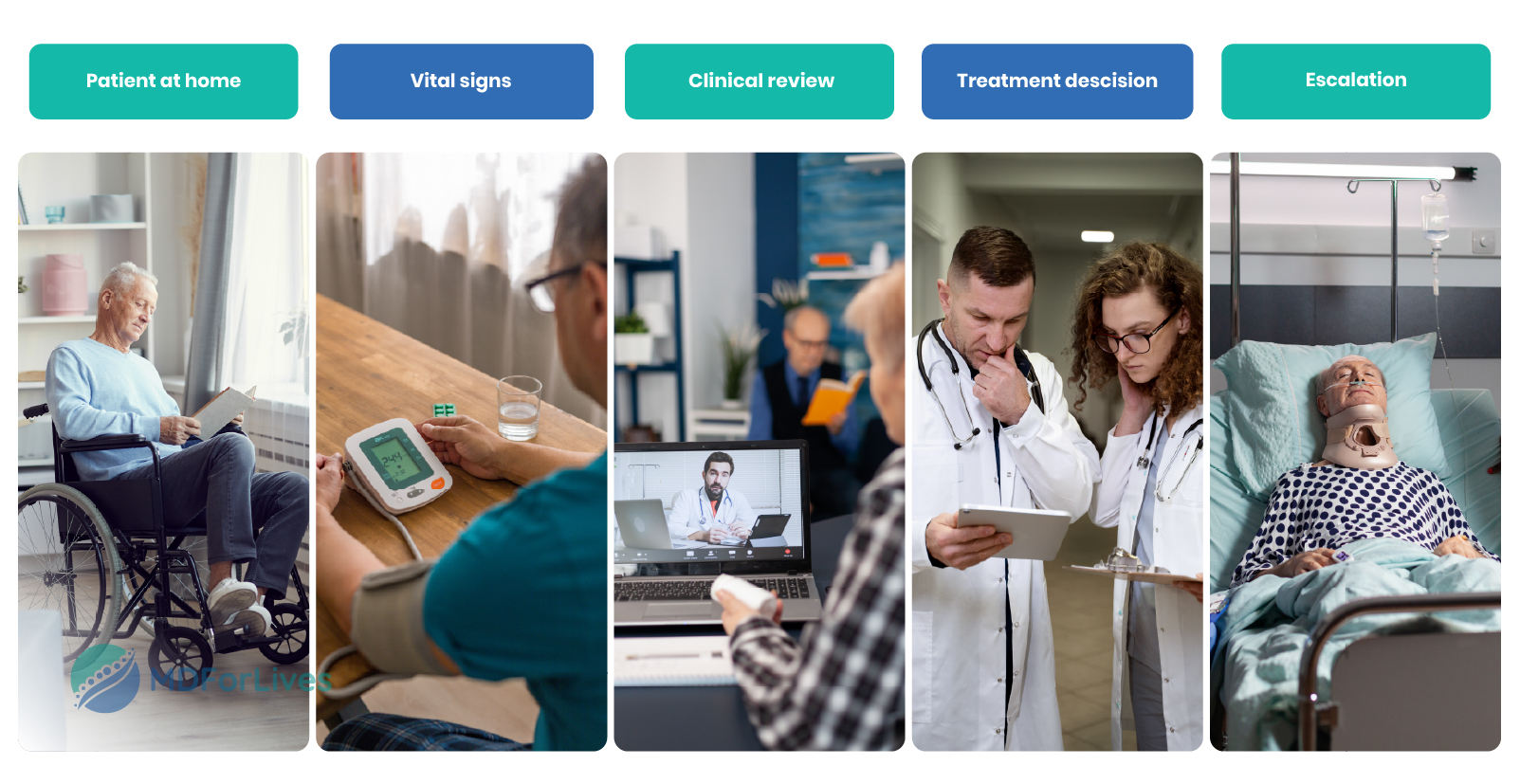
Home-based care can appear straightforward while the patient is stable; the difference shows when the clinical picture changes. In conventional home health care, deterioration may prompt a physician contact, assessment or transfer. In hospital-at-home, escalation should already be built into the acute-care pathway.
The service must anticipate what happens if symptoms worsen, vital signs change, treatment does not work as expected, an urgent test is needed, or the home can no longer support the patient. So acute hospital care at home requires both a plan for delivering treatment at home and a dependable route back to hospital-level resources, with clear boundaries around when care can safely remain there.
A hospital-at-home program must connect to the health system
Moving acute care home can create more interfaces, not fewer. As hospital clinicians, virtual teams, home nurses, pharmacy, diagnostics and transport become part of the same episode. In the MDForLives research, 34.6% of leaders identified workflow integration failures as the most common cause of hospital-at-home implementation failure.
The point is not just that integration is difficult, but that the weak point may sit between capable services. A monitoring system can work while the alert pathway fails, diagnostics can be available while results do not reach the right clinician in time, and home and hospital teams may both deliver high-quality care while ownership of the next decision stays unclear. For professional, handoffs, documentation, escalation, and shared visibility are part of the clinical model.
Connected healthcare infrastructure helps hospitals coordinate technology, clinical teams and patient information across care settings. Explore smart hospital technologies, their benefits, challenges and future.
Scaling means making acute care at home repeatable
Small hospital-at-home programs often rely on experienced teams solving problems manually, which gets harder as patient numbers, diagnoses, hours and locations increase. In the MDForLives survey, 61.5% of healthcare leaders selected standardized virtual-care pathways as their primary strategy for scaling hospital-at-home care.
This does not mean that every patient follows exactly the same care pathway. It means that the core processes; referral, eligibility assessment, monitoring, clinical responsibility, diagnostics, escalation, transfer, and discharge are clearly defined and consistently followed. Standardization gives AHPs and clinical teams a reliable default while preserving judgment for individual needs.
Closing perspective: the home is the setting, not the definition
The difference between home health care and acute hospital care at home is not the address, but the level of care delivered, and the system required to support it. Home health care supports recovery, rehabilitation and monitoring outside hospital; hospital-at-home is for selected patients who need acute, hospital-level care but can receive it safely through a structured home-based pathway.
That requires more than eligibility; treatment delivery, clinical visibility, diagnostics, coordination, escalation, and connection back to the wider health system. For management and leaders, the useful question is not whether more care can move home, but whether the organization can preserve the reliability of acute hospital care when the patient is outside hospital walls.