
A crowded emergency department tells hospital teams about a capacity problem that already exists. Patients wait, admitted patients on board, and staff escalate bed requests while diagnostics, transfers and discharge decisions compete for attention. The more useful question is whether hospitals can see pressure building before the queue becomes visible. That is where AI in Healthcare and predictive operations become relevant. Rather than showing only what capacity looks like now, predictive tools can flag where demand and resources may move out of balance hours or days ahead.
To understand where leaders see that opportunity, MDForLives surveyed hospital administrators across the USA and UK. The detailed findings and methodology are available in the MDForLives Hospital Patient Flow: Why Throughput Bottlenecks Persist Beyond Bed Capacity Insight Report.
The visible queue may be a late warning
Hospital congestion is most visible where patients wait, but the underlying bottleneck may be elsewhere in the patient’s journey. A crowded emergency department, for example, can reflect a downstream constraint rather than a problem within the ED alone.
In the MDForLives survey, 50% of hospital administrators identified inpatient bed assignment as the process creating the greatest throughput bottleneck. This finding highlights why visible queues are often lagging signals. The value of prediction in hospital patient flow management is to identify where flow is likely to break before delays become visible.
Healthcare demand forecasting should predict pressure, not just volume
Knowing tomorrow may bring more patients does not tell teams what will be constrained. Hospitals need to understand what that demand requires. How many patients need admission, which services face pressure, and which discharges may release capacity before the peak. This is where healthcare demand forecasting becomes more useful than historical reporting. The MDForLives survey reinforces this need: 50% of administrators identified AI-driven demand forecasting as the development most likely to transform patient flow over the next three to five years. Its greatest advantage is lead time; giving teams an earlier opportunity to anticipate constraints and adjust plans before pressure peaks.
Hospital capacity management is about usable capacity
A hospital may have physical beds and still have a capacity problem, because a bed is useful only when the staff, diagnostics, support services and workflows for the next patient are available. That makes hospital capacity management a question of deployable capacity, not bed count.
Hospital capacity challenges extend beyond staffing numbers. Workflow inefficiencies, coordination gaps and resource allocation also influence how effectively hospitals deliver care. Explore why staffing isn’t the only problem facing healthcare organizations.
AI may estimate future pressure, but predicting occupancy is not enough unless teams can see whether that capacity will be staffed and usable.
A useful forecast should already have an action attached
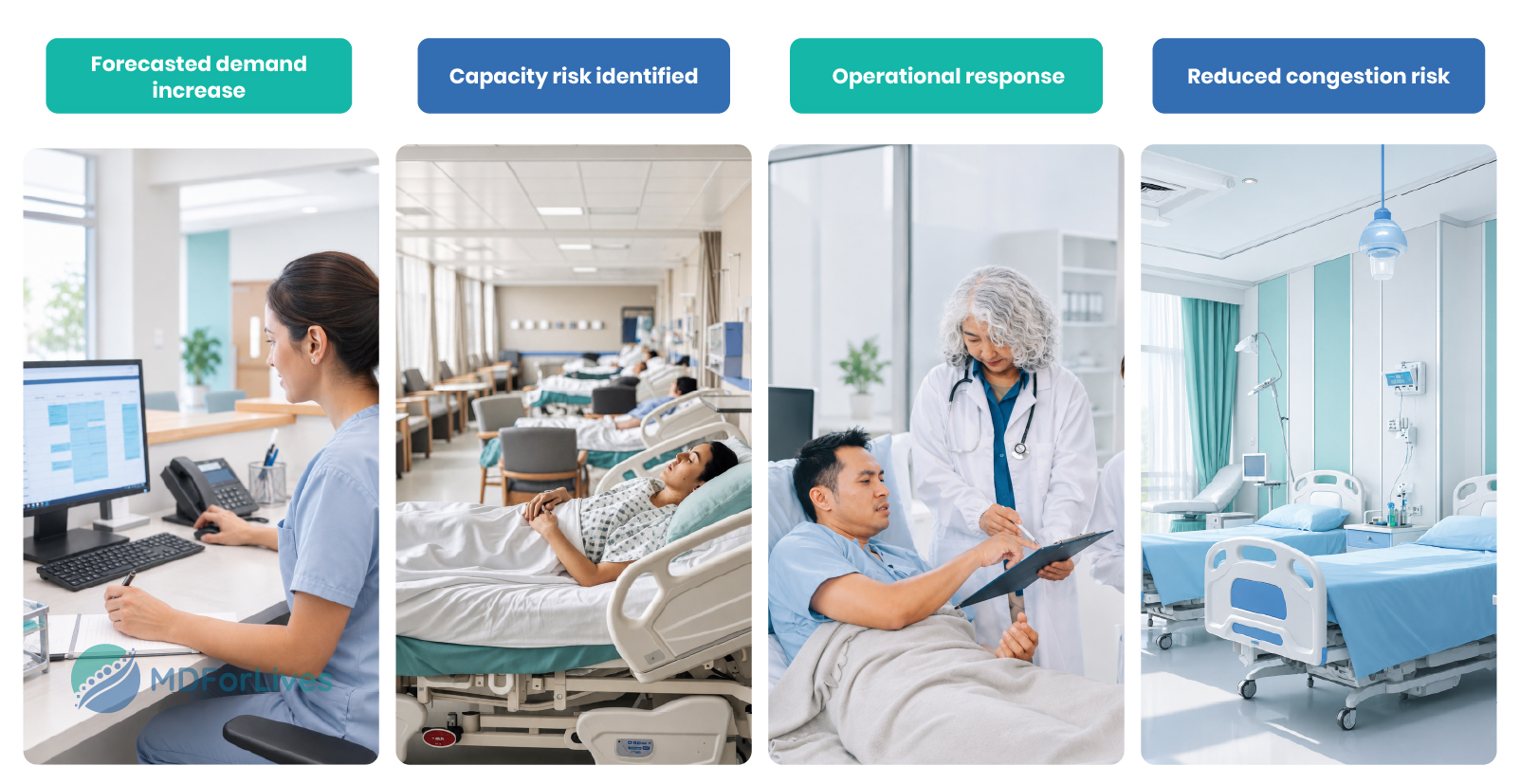
One risk with predictive analytics in healthcare is creating another dashboard that teams can see but do not know how to act on. A forecast becomes useful only when it leads to a clear response. If demand is expected to exceed staffed capacity tomorrow afternoon, what should the hospital do today?
That might mean starting discharge reviews earlier, adjusting staffing plans, or protecting diagnostic capacity. The key is to define who is responsible and what action should happen when certain thresholds are reached. Without that connection, hospitals may become better at predicting congestion without becoming better at preventing it.
Forecasting capacity means looking at discharge too
Predicting who may need a bed is only one side of hospital capacity planning; hospitals also need to know which beds are likely to become available, which makes discharge part of the forecasting problem. In the MDForLives survey, 62.5% of administrators selected inpatient-to-discharge as the patient-flow transition requiring the greatest redesign. A patient may be clinically ready to leave while medication reconciliation, documentation, transport or post-acute services are unresolved. If those dependencies appear late, an expected discharge becomes an occupied bed and a planned admission becomes a queue.
Predictive capacity planning therefore looks in two directions: who is likely to need capacity, and how much is likely to be released. Forecasting demand without usable supply gives only half the picture.
Better prediction cannot rescue an unresponsive workflow
AI can warn that pressure is coming, but it cannot independently create capacity. That matters because 75.0% of administrators in the MDForLives survey selected redesigning patient-flow workflows as the primary strategy for improving throughput, not expanding physical capacity. Capacity can remain trapped inside delayed decisions, fragmented handoffs, and poor coordination.
A predictive tool may identify tomorrow’s pressure, but if diagnostics are delayed, discharge barriers unresolved or transfer responsibilities unclear, it does not remove the constraint. AI and workflow redesign therefore reinforce each other: prediction creates earlier visibility; workflow design determines whether the organization can use it.
Connected hospital technologies can help healthcare organizations improve operational visibility, coordinate resources and support better patient flow. Explore how smart hospitals are transforming modern healthcare.
Hospital demand forecasting should follow the patient journey
Capacity problems rarely stay within one department. A delay in diagnostics, admission, transfer, or discharge can quickly create a queue elsewhere. That is why hospital demand forecasting should look beyond arrivals and bed occupancy to identify where the next bottleneck may appear.
The goal is not perfect prediction, but earlier visibility of emerging pressure so teams can act before patient flow is disrupted.
AI should support operational judgment, not replace it
The promise of AI in Healthcare can make forecasting sound more certain than it is. Hospital demand is influenced by seasonality, patient acuity, staffing, service availability, and local conditions. A model may also perform differently when used in an environment unlike the one it was trained on.
‘That is why reliable data, validation, interpretability, and human oversight matter.’
AI should support professional judgment, not replace it. Its greatest value comes when teams combine early warnings with real-world knowledge of staffing, services and local constraints to decide what action is actually possible.
Closing perspective: prediction matters when it creates time to act
The real opportunity for AI in Healthcare is not simply to predict a busy day. It is to identify where capacity pressure is likely to emerge early enough for hospitals to respond across staffing, diagnostics, bed planning, discharge, transfers, and escalation. This approach recognizes that usable capacity depends not only on beds, but also on the people, information, and services that support them.
For hospital administrators and AHPs, the question should move beyond how accurate demand can be forecast to a better one, which is what can we do differently today because we know where tomorrow’s pressure may appear? That is when forecasting becomes part of hospital patient flow management, not another way of describing congestion after the queue has formed.