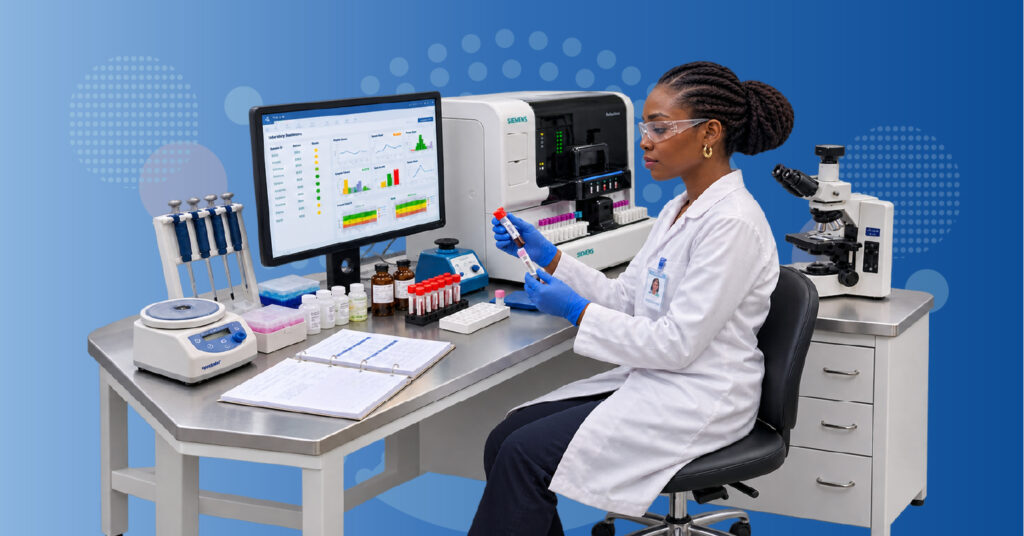
A laboratory can automate a task without improving the whole workflow. A specimen may reach analysis faster, a result may be released with fewer manual steps, and robotic handling may cut repetitive work. But if identification controls, interfaces, exception handling or quality review are weak, speed alone does not make the laboratory smarter.
That is the central challenge of laboratory automation. The goal is not to remove manual activity, but to make routine work move more efficiently while preserving professional oversight where variability, uncertainty and clinical significance make it necessary.
To understand how laboratory leaders approach that balance, MDForLives surveyed laboratory managers, supervisors and directors across the USA, UK and Canada. The detailed findings are available in the MDForLives Laboratory Automation: Where Scale, Quality, and Human Oversight Collide Insight Report.
Start with the workflow, not the machine
Define the problem before choosing the technology: New analyzers, robotic platforms and middleware may promise greater throughput or faster turnaround, but their value depends on the specific challenge the laboratory needs to solve. A delay in specimen receiving requires a different response from a bottleneck in sample preparation, limited analytical capacity or repeated manual result review.
Map the workflow and locate the constraint: Identify where specimens wait; handling steps are repeated, rework accumulates, and routine decisions consume professional time. This reveals the bottleneck that most limits performance.
Automate impact: Prioritize the constraint that most needs to change, not simply the task that is easiest to automate. A workflow-first approach shifts the decision from which system to buy to where automation can create the greatest operational value.
Connected automation creates more value than isolated tasks
Once the bottleneck is clear, how broadly should automation connect to the laboratory? In the MDForLives research, 50.0% of respondents selected total laboratory automation as the capability offering the greatest operational value.
A connected laboratory automation workflow brings specimen movement, analytical systems, middleware, information systems and result-release rules into one pathway, so routine work moves with fewer handoffs. But connected automation creates connected dependencies: an interface problem may affect several downstream steps. A routing rule determines where specimens move, and an auto verification rule determines which results reach review.
Faster laboratory workflows depend on more than automated equipment. Delays across the testing process can influence how quickly results reach clinicians. Understand how laboratory turnaround time affects diagnostic efficiency and healthcare delivery.
Faster testing still depends on getting the specimen right
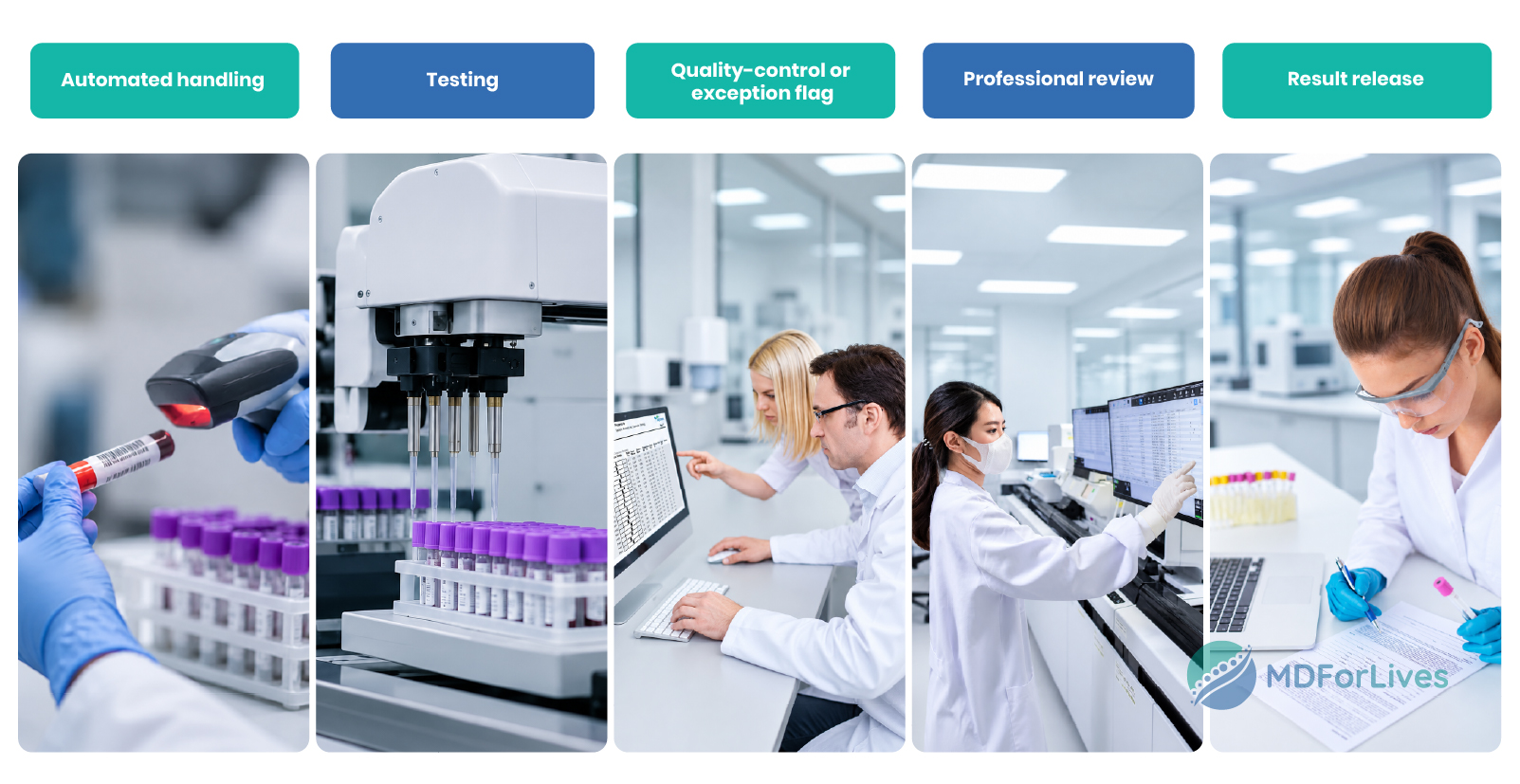
Automation can improve the speed and consistency of a well-designed process, but it can also allow an error to move through the workflow more quickly. This is particularly important before analysis and when results are released. In the MDForLives survey, specimen identification errors and automated result verification were each selected by 41.7% of respondents as leading perceived quality risks.
If a specimen is incorrectly identified at the start, automation does not fix the mistake. It can simply carry that error further through the testing process before it is detected. Automated result release can also reduce manual review, but only when the rules deciding which results can be released safely have been properly validated.
For automated laboratory testing, speed therefore needs to be supported by strong controls around specimen identity, specimen integrity, routing, and result-release criteria.
Human oversight becomes more targeted as automation grows
A highly automated laboratory does not need people to check every predictable step; it needs people where professional judgment adds the most value. In the MDForLives research, 41.7% of laboratory leaders identified quality-control review as the area where the strongest human oversight should remain.
Routine, predefined activity may suit automated processing, so human attention can concentrate on failed quality-control rules, specimen-integrity concerns, unexpected discrepancies, complex interpretation or a pathway not behaving as intended. Human oversight therefore becomes more focused, not less important.
Validation should follow uncertainty through the workflow
Connected automation works best when laboratories understand not only the normal pathway, but what happens outside it. Since complex specimens, new interfaces and changing decision rules introduce uncertainty even when components perform correctly. Validation therefore examines laboratory automation systems within the local workflow, not every component isolated.
A robust workflow does more than process normal cases efficiently. It makes deviations visible and gives teams a clear route for responding, with a clear owner, when a specimen, interface or result does not follow the expected pathway.
Scale still needs a business case
Laboratory leaders in the MDForLives research identified faster turnaround and higher testing throughput among the outcomes supporting continued investment. But expansion still has a significant barrier. 75% of respondents identified capital expenditure requirements as the factor most limiting automation scale-up.
The question is not only whether the technology works, but whether improving this workflow creates enough measurable value to justify expanding it. A useful business case therefore looks beyond installation. Turnaround time, throughput, workload, quality, downtime and staff capacity can all show whether automation has improved how the laboratory operates, and scaling is easier to justify when the benefit shows in the workflow, not only the equipment list.
The next phase may automate decisions, not just movement
Laboratory automation has traditionally focused on physical tasks such as specimen transport, sorting, preparation, and analytical testing. The next phase may move closer to decision support. In the MDForLives survey, 45.5% of respondents selected AI-assisted result interpretation as the development most likely to transform laboratories over the next three to five years.
That creates an important governance challenge. If a system helps prioritize or interpret results, laboratories need clear rules for validation, professional review, exception handling, and accountability.
Explore how AI is moving beyond routine laboratory automation and becoming an active part of clinical workflows. Discover how clinical laboratories can balance AI innovation with accountability and human oversight.
The principle is simple: as automation takes on more decision-making, the boundaries for human oversight must become clearer.
Closing perspective: automate the routine and protect the critical
The success of laboratory automation should not be measured by how few people touch a specimen, but by whether the workflow becomes faster, more consistent and easier to control without weakening quality. That starts with identifying the real bottleneck, then connecting automation to improve flow, validating where specimens and decisions become less predictable, and keeping oversight closest to exceptions and clinically significant decisions.
As AI-assisted interpretation and intelligent workflow orchestration develop, this balance matters even more. The most useful principle may be simple: automation should make routine work easier to move and important exceptions harder to miss. For laboratory managers, supervisors and directors, that may be the clearest definition of a smart lab: not a laboratory without people, but one where technology handles predictable work efficiently and expertise stays concentrated where quality depends on it.