Cancer treatment is often explained through clinical words: response, progression, toxicity, cycles, scans, survival, remission.
Patients live it through different words: waiting, hoping, adapting, losing routine, managing exhaustion, trying to stay positive, wondering whether symptoms mean the treatment is working or the cancer is changing.
That is the gap behind the cancer treatment experience.
Immunotherapy and chemotherapy are often discussed as different treatment approaches. Chemotherapy directly targets rapidly dividing cells, while immunotherapy helps the immune system recognize and attack cancer. Both can be important in care, and both can affect patients in ways that reach beyond clinical outcomes.
MDForLives survey data shows that patients are not only thinking about side effects. Many are trying to carry uncertainty, emotional stress, identity changes, and the pressure to remain hopeful while treatment reshapes daily life.
This Is Not Just a Treatment Comparison
In the MDForLives survey data, 60.0% of respondents had experienced chemotherapy, while 40.0% had experienced both chemotherapy and immunotherapy. No respondents in this dataset reported immunotherapy alone.
That matters.
This article should not be read as a head-to-head comparison of which treatment is clinically better or easier. The stronger insight is about the cancer treatment experience across real patient journeys, especially what patients report beyond treatment category.
The most important finding is that patients do not experience treatment only as a medical event. They experience it as a daily-life disruption, an emotional test, and a continuing negotiation between hope and uncertainty.
Before Treatment, Effectiveness Was the Biggest Fear
Before treatment began, 60.0% of respondents said their biggest concern was whether the treatment would work. Side effects followed at 30.0%, while impact on daily life was selected by 10.0%.
This finding is important because it shows what sits at the center of patient worry: uncertainty about benefit.
Side effects matter, but many patients first want to know whether the difficult treatment ahead will be worth it. That is especially true when treatment may involve repeated cycles, visible body changes, immune-related risks, fatigue, or ongoing monitoring.
For oncology teams, this means treatment conversations cannot focus only on what may happen physically. Patients also need help understanding what uncertainty feels like, how treatment response will be assessed, and what signs should or should not be interpreted too early.
Choosing immunotherapy can involve questions about expected benefit, uncertainty, treatment options, and individual patient factors. Explore how patients navigate precision cancer care and immunotherapy decisions.
Treatment Does Not Feel the Same Over Time
When patients compared the actual treatment experience with their expectations, 30.0% said it was easier than expected, 30.0% said it was about what they expected, 20.0% said it was harder than expected, and 20.0% said it changed over time.
That spread is meaningful.
It suggests that the cancer treatment experience is not fixed. A patient may feel prepared at the start, then become more exhausted later. Another may fear the worst and find treatment manageable. A third may cope physically but struggle emotionally between appointments.
This is why one-time counseling before treatment may not be enough. Expectations need to be revisited as treatment continues.
Advances in oncology can expand treatment possibilities, but progress does not always translate into a simple or predictable patient experience. Explore why progress in oncology can still feel uneven in practice.
What Others Don’t See: Uncertainty and Positivity Pressure
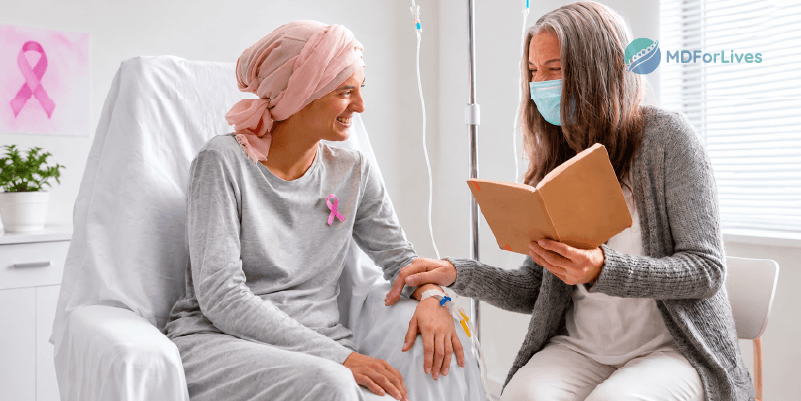
When asked what felt least visible to others during treatment, 30.0% selected emotional uncertainty, and another 30.0% selected the pressure to “stay positive.” Exhaustion between treatment cycles followed at 20.0%.
This is one of the strongest patient-experience insights.
Cancer care often encourages strength, hope, and resilience. Those can help. But patients may also feel pressure to perform optimism for family, friends, or even care teams. That pressure can make distress less visible.
One open-ended response captured this clearly: “It’s hard to explain to someone that you are sick or not feeling well emotionally when you physically look fine on the outside. You lose so much more of yourself than just your hair.”
That sentence explains why the cancer treatment experience cannot be judged only by whether a patient “looks well.” Some of the hardest parts are not visible.
The Hardest Trade-Off Was Staying Hopeful
The hardest treatment trade-off was staying hopeful despite uncertainty, selected by 40.0%. Continuing treatment despite emotional exhaustion followed at 30.0%, while balancing treatment with normal life was selected by 20.0%.
This suggests that patients are not only weighing side effects against benefit. They are weighing emotional endurance against uncertainty.
A treatment plan may be clinically appropriate, but the patient may still wonder: Is this working? How long will this last? Will I feel like myself again? What happens if this stops working? How much longer can I keep going like this?
This is where oncology communication must go beyond consent and side-effect lists. Patients need space to discuss the emotional mathematics of treatment: what they are giving up, what they hope to gain, and what support they need to continue.
The Emotional Impact Was Harder Than Expected
When asked which statement best matched their experience, 50.0% said the emotional impact was harder than expected. Daily life disruption was harder than expected for 20.0%, while 20.0% said treatment was more manageable than expected. Only 10.0% selected physical effects as harder than expected.
This does not mean physical symptoms are minor. Patients described fatigue, body changes, sickness, side effects, and treatment cycles as difficult.
But the strongest reported surprise was emotional.
The cancer treatment experience may be physically demanding, but patients often discover that the emotional burden is harder to prepare for. This includes waiting for results, fearing recurrence or progression, uncertainty after chemotherapy, not knowing whether symptoms come from treatment or cancer, and feeling disconnected from normal life.
Patients Wanted More Open Discussion Before Treatment
Looking back, 40.0% wished doctors had discussed long-term side effects more openly before treatment. Emotional impact followed at 30.0%, and chances of treatment success at 20.0%.
This finding shows a communication gap.
Patients do not only want technical accuracy. They want practical preparation. What might happen months later? What changes could last? What emotional responses are common? What should they report? What changes are expected, and what needs attention?
Cancer treatment conversations need to prepare patients for more than clinical outcomes. Explore the communication gap between what patients are told and what they need to know.
A better cancer treatment experience may depend on earlier, clearer conversations about what life during and after treatment can feel like.
What Healthcare Teams May Understand Least
When asked what healthcare teams understand least about patient treatment experience, 40.0% selected the pressure patients feel to remain optimistic, and 40.0% selected the difficulty balancing treatment with personal identity.
This is the deepest insight from the survey.
Treatment can change how patients see themselves. One respondent described chemotherapy as leaving them with “essentially a new body” they had to learn to live with. Another described the disconnect between normal life and patient care. Others mentioned emotional toll, fatigue, side effects, uncertainty, and the difficulty of continuous treatment.
For patients, treatment is not only something they receive. It becomes something they live around.
Closing Perspective
The clinical goal of cancer treatment is critical. But patients also experience treatment through uncertainty, emotional strain, body changes, family impact, identity shifts, and the daily effort of continuing.
MDForLives survey data shows that patients want cancer care conversations to include more than effectiveness and side effects. They want more honest preparation around emotional impact, long-term effects, daily-life disruption, and what it really feels like to stay hopeful when outcomes are uncertain.
The future of patient-centered oncology should not separate clinical outcomes from lived experience.
Because treatment success is not only measured on a scan.
It is also felt in the days between appointments, in the energy patients try to recover, in the identity they try to hold onto, and in the support they receive when optimism becomes hard work.