

When a migraine attack begins, the immediate goal is reducing the pain and returning to normal.
But migraine treatment is not only about what happens during an attack. You may get some pain relief and still deal with disrupted work, poor sleep, unpredictable attacks, or difficulty returning to your routine.
To understand that wider experience, MDForLives surveyed people living with migraine across the USA, UK, Canada, Italy, France and Germany. The detailed findings and methodology are available in the MDForLives Migraine Treatment and Stress: Why Better Control Needs More Than Pain Relief Insight Report.
Migraine pain relief is only one part of control
Migraine can affect more than head pain. You may also experience fatigue, disrupted sleep, sensitivity to light or sound, difficulty concentrating, or worry about the next attack.
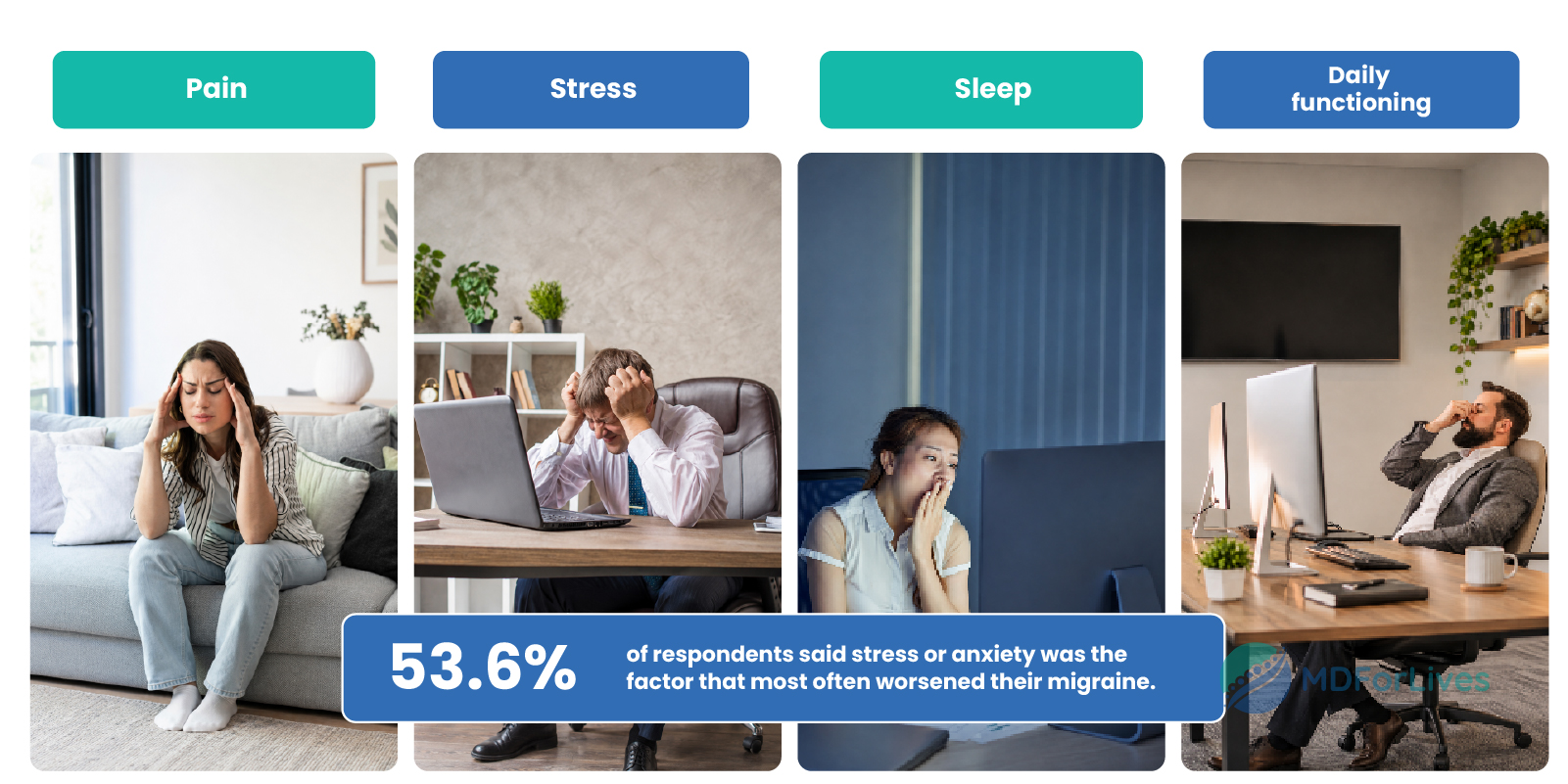
In the MDForLives survey, 53.6% of respondents said stress or anxiety was the factor that most often worsened their migraine. Though that does not mean stress causes migraine. Migraine is a neurological condition, and the things that worsen attacks can vary between people.
Migraine pain relief may not tell the whole story. If pain improves but sleep, energy or daily functioning remain affected, migraine may still not feel well controlled.
Migraine can continue affecting everyday life even after an attack has passed. Explore why chronic migraine affects patients beyond the pain of an individual attack.
Acute migraine treatment should have a clear role
During an attack, people often reach for what is familiar and easy to access.
In the MDForLives survey, 43.6% of respondents reported using over-the-counter pain medicine as their first action during a migraine attack. For some people, that may provide enough relief. For others, attacks remain frequent, disabling, or only partly relieved.
That is where acute migraine treatment needs to fit into a broader plan. It can help to know which treatment to use, when to use it, and when repeated use should prompt a conversation with a healthcare professional.
If you are treating attack after attack without feeling that migraine itself is becoming more manageable, the question may need to change from “What should I take this time?” to “Is my overall treatment plan doing enough?”
Stress can remain part of the treatment gap
Even when migraine medications improve headache symptoms, other parts of the migraine experience may remain difficult.
In the MDForLives survey, 39.4% of respondents identified uncontrolled stress or anxiety as the biggest limitation of their current migraine treatment.
This does not mean migraine is caused by stress. But if stress, poor sleep or anxiety repeatedly make migraine harder to manage, they may be worth discussing alongside attack frequency and medication response.
Stress-management or mental health support is not a replacement for appropriate migraine care. But if these factors are affecting symptoms or daily life, they may need to be part of the wider plan.
Poor control should lead to a next-step conversation
Your migraine plan may need review if daily life is still being disrupted. Attacks may remain frequent, medicines may not provide enough relief, or recovery may continue to interfere with work or normal activities.
In the MDForLives survey, 40.7% of respondents said their treatment was not escalated after inadequate migraine control.
That does not mean treatment should automatically be changed. It raises a useful question: if your current treatment is not working well enough, do you know what the next step is?
A review may include your migraine pattern, acute medication use, side effects, and whether migraine prevention should be discussed. Poor control does not automatically mean a stronger medicine is needed. It means the current plan is worth reviewing.
When existing migraine treatments do not provide enough control, newer therapeutic options may offer additional possibilities. Explore how new migraine treatments beyond triptans are changing migraine management.
Migraine prevention should make everyday life easier
Preventive treatment is often discussed in terms of reducing migraine days. That matters, but patients may judge success more broadly.
In the MDForLives survey, 44.4% of respondents said better daily functioning was the main factor influencing whether they stayed with preventive treatment, compared with 33.3% who selected fewer monthly migraine days.
You may have fewer attacks but still avoid making plans because migraine feels unpredictable. Or migraine days may decrease while fatigue or recovery time continues to interfere with normal life. Successful migraine prevention should therefore be considered in terms of both frequency and function.
Preventive migraine treatment aims to reduce the burden of recurring attacks and improve everyday functioning. Learn more about erenumab, its uses, administration and how it works.
Tracking migraine days can be useful, but so can track what migraine stops you from doing.
Better migraine management may need a more personal plan
There is no single migraine plan that works for everyone. Attack patterns, triggers, treatment response, side effects and impact on daily life can all differ.
In the MDForLives survey, 35.2% of respondents selected personalized preventive treatment as the future improvement that would help them most.
Personalization does not necessarily mean using the newest treatment. It means asking whether the plan fits you.
Does acute treatment provide enough relief? Is migraine still affecting sleep or routine? Is stress or anxiety making control more difficult? Is migraine prevention appropriate? Are side effects, cost or access making the plan difficult to follow?
The goal of personalized migraine management is not simply to add more treatment. It is to identify what is still leaving you with a meaningful migraine burden.
Closing perspective: better control means more than stopping the pain
Pain relief remains an important part of migraine treatment. But pain relief alone does not always mean migraine is well controlled.
The MDForLives findings point toward a wider picture. Stress and anxiety may still matter; poor control may continue without a clear next step, and preventive treatment may feel most worthwhile when everyday life becomes easier.
The question is not only, “Did treatment reduce the migraine?” It is also, “Did treatment reduce the amount of life that migraine takes away?”