
Cataract surgery is one of the ophthalmologists’ most standardized and efficient procedures. This procedure consistency depends on predictable instrumentation, sterile supplies, controlled workflow, and rapid turnover. Yet the same system can generate a large material footprint when disposable packs, drapes, plastics, packaging, medications, and single-use components are repeated across every case.
Because cataract surgery is high volume, small material choices scale quickly. The practical sustainability question is therefore not simply how to use less, but where avoidable waste can be removed without weakening sterility, workflow reliability, visual outcomes, or professional accountability.
To understand where that balance becomes difficult, MDForLives surveyed ophthalmologists and cataract surgeons across six countries. The detailed findings are available in the MDForLives Sustainable Cataract Surgery Insight Report. The more useful question here is what those findings mean for teams trying to make a high-volume cataract pathway less wasteful while keeping safety non-negotiable.
Before the case: question what needs to enter the OR
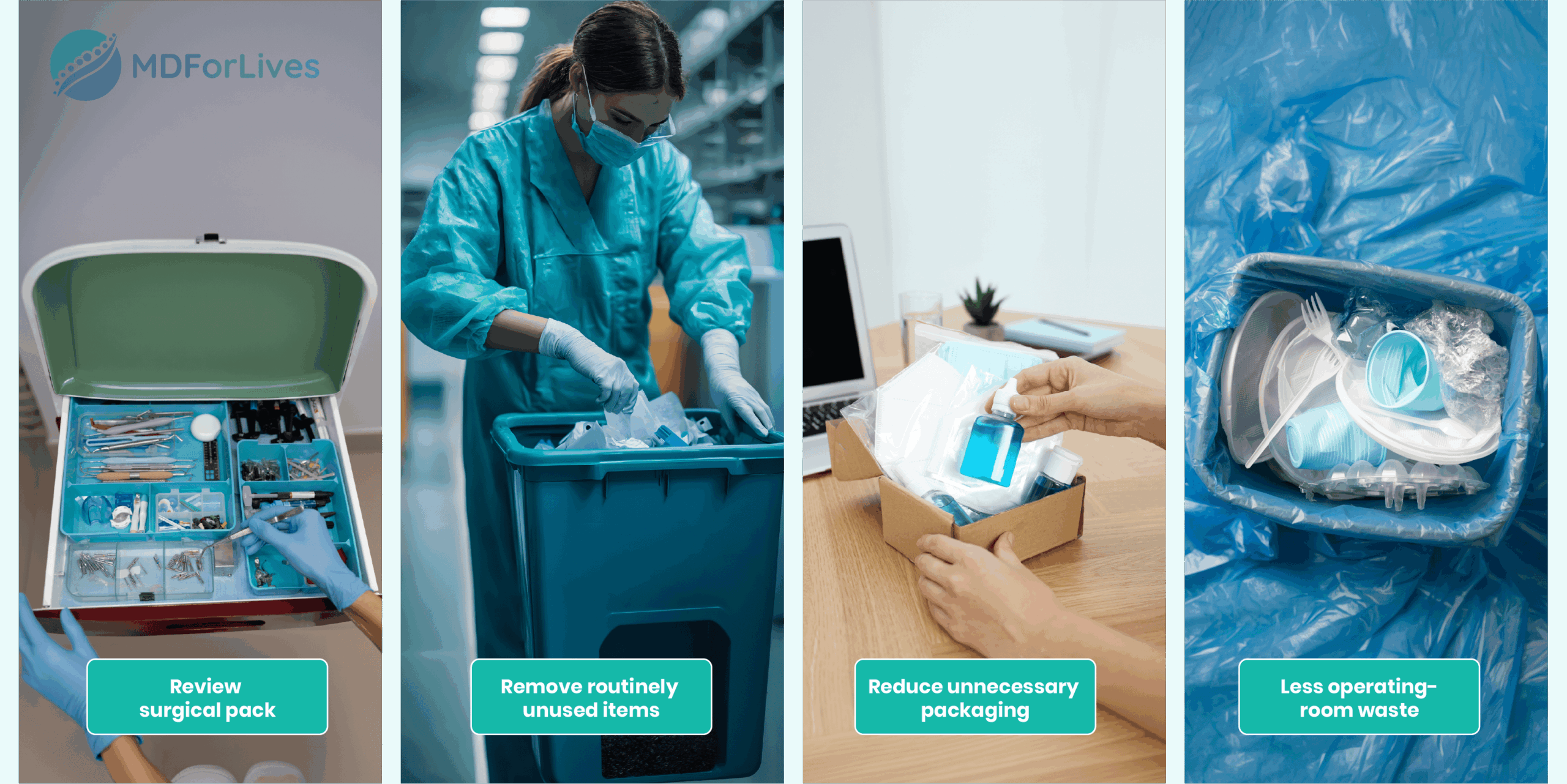
Clinicians most often identified disposable surgical packs and drapes as the largest source of unnecessary waste, at 35.6%, followed closely by single-use plastic consumables at 31.1%.
Understanding the key steps involved in cataract surgery can also provide useful context for the clinical workflow discussed here.
The practical insight is that much of the waste is designed into the pathway before the first incision. Standardized packs support efficiency, but they may also include items that are routinely opened and discarded unused. For cataract teams, waste reduction starts by reviewing what enters the room, not only by improving what happens to waste after the case.
When reuse is considered, validation matters more than intent
Support for reuse rises when the clinical boundary is clear. In the MDForLives survey, 47.7% supported transitioning toward reusable instruments and multi-dose pharmaceuticals when safety, sterility, and visual outcomes were equivalent, while 38.6% strongly supported it.
The relevant opportunity is validated reuse, not reuse for its own sake. Product design, manufacturer instructions, cleaning and sterilization pathways, infection-control standards, and local regulation still determine what can be implemented. Once those conditions are satisfied, the issue shifts from clinician’s willingness to whether the surrounding system can support the change consistently.
These considerations also extend beyond cataract procedures to other ophthalmic interventions, including glaucoma surgery, where surgical preparation, instrumentation, and postoperative care require similarly structured protocols.
The harder barrier appears when policy meets practice
When asked for the single greatest barrier to more sustainable cataract protocols, 33.3% selected rigid national or institutional requirements that prohibit reusable items. Clinicians also pointed to infection-control concerns, perceived patient-safety risks, costs, and limited institutional support.
That makes sustainability more than an individual practice choice. A surgeon may support a lower-waste option but still work within manufacturer labelling, sterile-processing requirements, procurement contracts, and local rules that favor single use. Sustainable practice becomes scalable only when the lower-waste choice is also evidence-based, permitted, and professionally defensible.
Procurement can change the default before the case begins
Some changes do not require redesigning surgical technique. Asked which industry-led initiative could have the highest immediate impact, 34.1% selected reducing plastic packaging and paper inserts, while 29.5% selected lean custom packs designed to eliminate unused items.
Both interventions remove waste upstream. A leaner pack does not require a new decision during every cataract operation, and lighter packaging reduces material before it reaches the OR. This makes procurement a practical sustainability lever: teams can evaluate pack contents, packaging, reusable options, take-back pathways, and electronic instructions were permitted alongside cost, reliability, and clinical performance.
Moderate readiness means the next barrier is operational
Interest does not automatically translate into implementation. In the survey, 45.5% described their primary surgical facility as moderately prepared to adopt eco-conscious ophthalmic innovations over the next five years.
For clinical and operational leaders, that middle ground is useful. The missing dependency may be a sterile-processing protocol, staff training, procurement flexibility, infection-control approval, product availability, or clear ownership. Instead of asking whether a facility is broadly “ready,” teams can identify the specific condition preventing evidence-supported change from becoming routine.
The next step is a defensible reuse pathway
Looking three to five years ahead, 54.5% selected evidence-based global guidance for safe reuse of selected consumables as the advancement most likely to reduce cataract surgery’s environmental footprint. Professional societies and manufacturers were also the most frequently selected leaders, reinforcing that clinical guidance and product design need to move together.
Closing perspective: make the lower-waste choice easier to defend
The findings do not suggest that ophthalmologists need to be persuaded that waste matters. The stronger message is that willingness alone cannot redesign a cataract pathway.
Packs and plastics remain visible sources of waste; regulation can restrict reuse, and many facilities are only moderately prepared. The gap therefore sits between clinical intent and an operating system that makes sustainable choices practical, validated, and repeatable.
A comprehensive approach to cataract care also includes addressing conditions such as Dry Eye Disease when clinically appropriate to support patient outcomes.
For cataract teams, the goal is not to trade sustainability against patient safety. It is to align evidence, product design, regulation, procurement, sterile processing, and infection control so that, where appropriate, the lower-waste choice can become the validated default.