

How to not get disqualified from surveys is one of the most common concerns among participants who regularly encounter screen outs, quota limits, or unexpected terminations. These outcomes are built into survey design to ensure that only relevant participants complete the study. While they cannot be eliminated completely, understanding how surveys work and aligning your responses with their structure can significantly improve your completion rate and overall experience.
Survey Screen Out, Survey Quota Full and Survey Termination
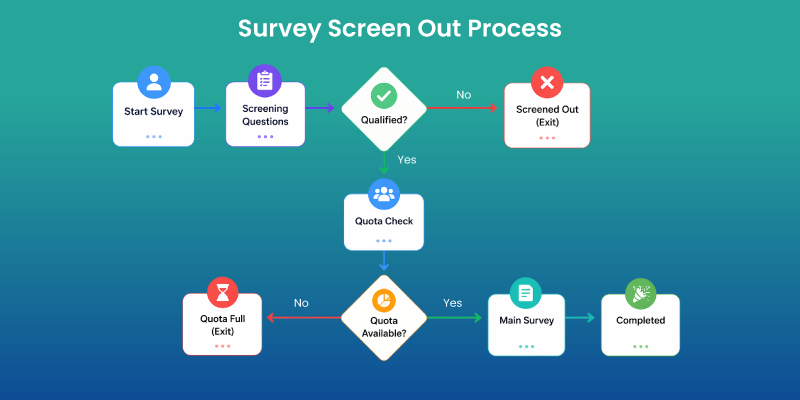
Survey platforms use multiple filtering mechanisms to maintain data quality and match the right participants to each study. These mechanisms often appear as different types of exits.
Survey Screen Out
A screen out occurs at the beginning of a survey when your responses do not match the required participant profile. Screening questions are used to determine eligibility based on demographics, profession, behavior, or experience.
For example, a survey targeting cardiologists will screen out participants who do not meet that criterion within the first few questions.
Survey Quota
Survey quota refers to the number of participants required for a specific segment. Once the required number is reached, additional respondents from that category are no longer accepted.
Even if you qualify, you may still see a quota message if many participants from your segment have already completed the survey.
Survey Termination
Termination happens after you have started answering the survey, but your responses do not meet consistency checks or required conditions. This often occurs when answers conflict with earlier responses or when attention checks are failed.
Why Do You Get Disqualified from Surveys?
Disqualification is a result of how surveys are designed, not a reflection of participant performance.
Researchers create highly specific target groups to ensure the data collected is relevant. These groups are defined using multiple parameters such as profession, experience level, geographic location, and usage behavior.
Beyond eligibility, data quality plays a major role. Survey systems monitor response patterns, timing, and consistency. If responses appear rushed, random, or contradictory, the system may terminate participation to maintain accuracy.
Another factor is timing. Surveys often fill quickly, and participants who join later may encounter quota limits even if they meet all criteria.
Can You Completely Avoid Survey Disqualification?
No. It is not possible to completely avoid disqualification because surveys are selective by design. However, you can reduce how frequently it happens by improving alignment with survey requirements and maintaining consistent response quality.
The goal is not to bypass screening but to position yourself as a reliable and relevant participant.
15 Proven Tips to Avoid Getting Disqualified from Surveys
These strategies focus on improving participation quality and increasing match rates.
- Keep your profile updated with accurate information
- Select surveys relevant to your profession or background
- Read instructions carefully before responding
- Maintain consistency across all answers
- Avoid rushing through questions
- Participate early before quotas are filled
- Use honest and realistic responses
- Avoid multitasking during surveys
- Ensure stable internet connectivity
- Avoid switching devices mid-survey
- Pay attention to screening questions
- Avoid extreme or patterned responses
- Take breaks between surveys to stay focused
- Build a history of reliable participation
- Track which surveys you qualify for most often
These practices improve both eligibility and data quality signals.

Common Mistakes That Get You Disqualified Instantly
Certain behaviors increase the likelihood of immediate disqualification.
- Providing inconsistent answers across similar questions
- Completing surveys too quickly to be realistic
- Randomly selecting answers without reading questions
- Misrepresenting professional or demographic details
- Ignoring instructions or attention checks
These signals indicate low-quality responses and trigger automatic exits.
Advanced Strategies
Improving outcomes requires more than basic habits. A structured approach can make a measurable difference.
Choose the Right Platforms
Not all survey platforms are designed equally. Some are general, while others are tailored to specific audiences.
For example, healthcare professionals benefit from platforms such as: Healthcare Surveys and Healthcare Professionals Surveys
These platforms match participants with relevant surveys, reducing screen outs and improving completion rates.

Understand Survey Patterns
Over time, patterns emerge in the types of surveys you qualify for. Identifying these patterns allows you to prioritize similar opportunities instead of attempting every survey.

Build Consistency Over Time
Survey platforms often evaluate participant reliability over multiple attempts. Consistent, high-quality responses can improve your chances of qualifying for future studies.
Avoid Over participation in a Short Time
Taking too many surveys in a short period can affect response quality. Maintaining focus and accuracy is more effective than maximizing volume.
What to Do If You Keep Getting Disqualified
Frequent disqualification usually indicates a mismatch between your profile and available surveys.
Start by reviewing your profile details. Ensure your information reflects your current role, experience, and background accurately.
Next, refine your survey selection. Focus on surveys that align with your expertise or demographics rather than attempting all available options.
If disqualification continues, consider switching to platforms that specialize in your field. Targeted platforms generally offer better matching and fewer screen outs.
Understanding Survey Design and Participant Matching
Surveys are built using predefined sampling frameworks. Researchers aim to collect data from specific participant groups to ensure validity.
This means that not every participant is expected to qualify. Screening questions act as filters, ensuring that only relevant responses are included.
Understanding this structure helps set realistic expectations and reduces frustration during participation.
Balancing Speed and Accuracy in Surveys
Speed is often misunderstood in survey participation. While faster completion may seem efficient, it can negatively affect eligibility.
Survey systems track response time as an indicator of engagement. Extremely fast responses are often flagged as low-quality.
A balanced approach that prioritizes accuracy over speed leads to better outcomes.
Long-Term Approach to Survey Success
Improving survey completion rates requires consistency over time.
Participants who focus on:
- Accurate profiles
- Consistent responses
- Relevant survey selection
tend to experience fewer disqualifications and better opportunities.
Survey participation should be viewed as a structured activity rather than a trial-and-error process.
Conclusion
Getting disqualified from surveys is a built-in part of the process, but it can be reduced with the right approach. Understanding how screening works, maintaining consistency, and choosing relevant surveys are key to improving outcomes. Instead of trying to avoid disqualification entirely, focusing on alignment and quality leads to better long-term results.
Explore more opportunities and insights: MDForLives